










































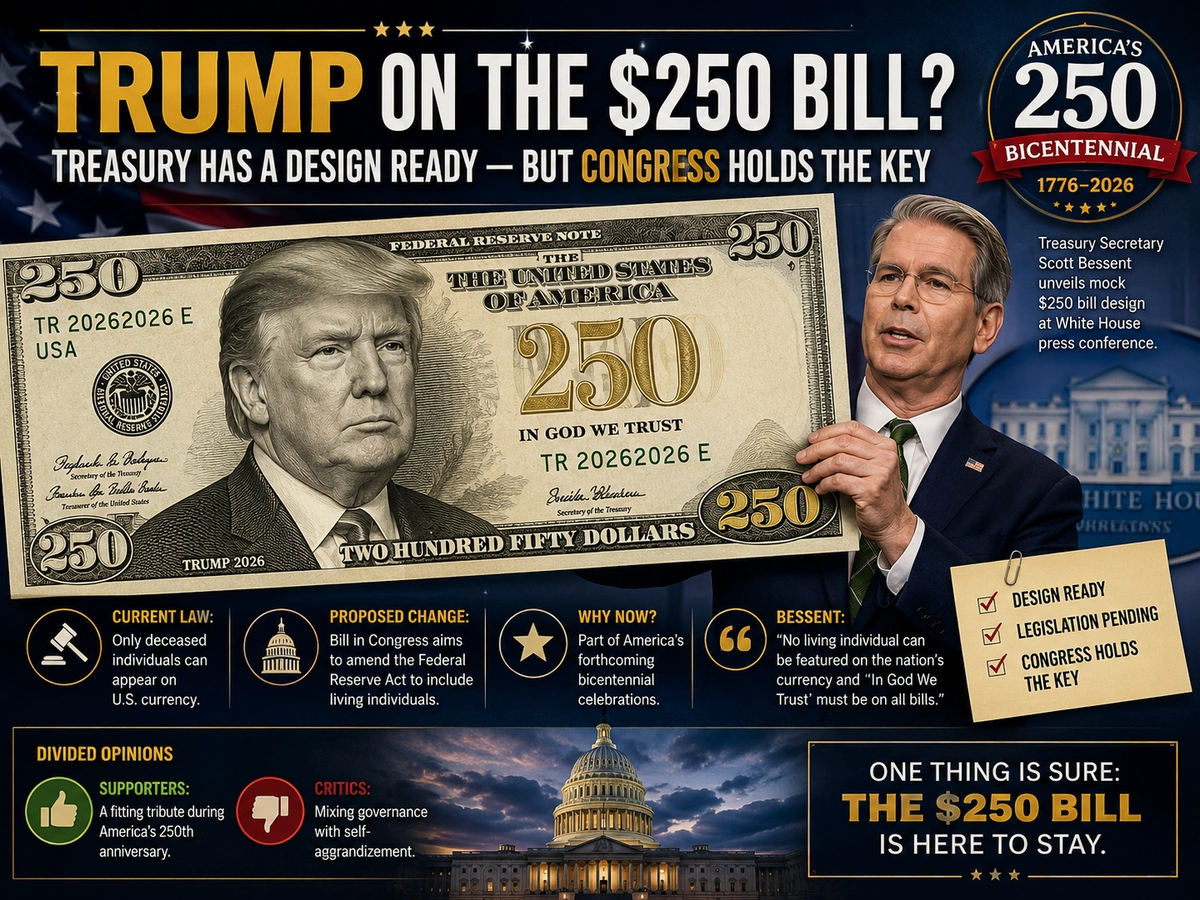
Trump on the $250 Bill? Treasury Has a Design Ready — But Congress Holds the Key
The possibility of a new $250 bill featuring President Donald Trump has become one of the most discussed political and financial stories in the United States this week. While the proposal remains far from becoming reality, its emergence has reignited debate about who should appear on American currency and whether long-standing traditions should be revised ahead of the nation’s bicentennial celebrations.
According to Treasury Secretary Scott Bessent, the U.S. Treasury has already prepared a conceptual design for a $250 banknote bearing Trump’s portrait. However, current federal law presents a major obstacle: living individuals are not permitted to appear on U.S. currency.
A Proposal Rooted in America’s Bicentennial
Supporters of the initiative argue that the proposal aligns with broader efforts to commemorate the 200th anniversary of the United States. Lawmakers backing the measure are reportedly exploring legislation that would amend existing provisions of the Federal Reserve Act and permit a living individual to be featured on a commemorative banknote.
The proposal is being framed as part of a wider celebration of American history and leadership during a landmark national milestone.
During a recent White House press conference, Bessent unveiled a mock-up of the proposed note, attracting widespread media attention and sparking intense public discussion across political and financial circles.
The Legal Hurdle
Despite the excitement generated by the concept, federal law remains clear on the matter. For decades, U.S. currency policy has prohibited the depiction of living individuals on banknotes.
Bessent emphasized that the Treasury Department cannot act independently on the proposal.
According to the Treasury Secretary, any change would require legislative action from Congress before the note could move beyond the design stage. Until then, existing rules continue to govern the nation’s currency.
He reiterated that his responsibilities remain tied to enforcing current law, including requirements regarding who may appear on banknotes and the continued inclusion of the national motto, “In God We Trust.”
Supporters and Critics Clash
The proposed banknote has generated sharply divided reactions.
Supporters view the initiative as a historic tribute to a sitting president whose influence has shaped contemporary American politics. They argue that commemorative currency has long served as a symbol of national milestones and leadership.
Critics, however, see the effort differently. Many contend that placing a living political figure on currency risks blurring the distinction between public service and personal promotion. Some observers argue that changing a century-old tradition for a current political figure could set a controversial precedent for future administrations.
The debate reflects broader political divisions that continue to shape American public life.
More Than Just a Banknote
The controversy surrounding the proposed $250 bill extends beyond currency design. It touches on questions of national symbolism, historical tradition, political legacy, and the role of public institutions.
For supporters, the proposal represents a unique opportunity to mark America’s bicentennial with a bold and memorable gesture. For opponents, it raises concerns about preserving institutional norms and avoiding excessive personalization of national symbols.
Congress Holds the Final Decision
For now, the proposed $250 Trump banknote remains exactly that—a proposal.
While Treasury officials may have a design ready, the future of the bill ultimately rests with lawmakers on Capitol Hill. Unless Congress changes existing law, the note will remain a concept rather than a piece of currency.
As debate continues, one thing is certain: the discussion surrounding the proposed $250 bill has already become a powerful reflection of the broader conversations shaping America’s political and cultural landscape ahead of its bicentennial celebrations.