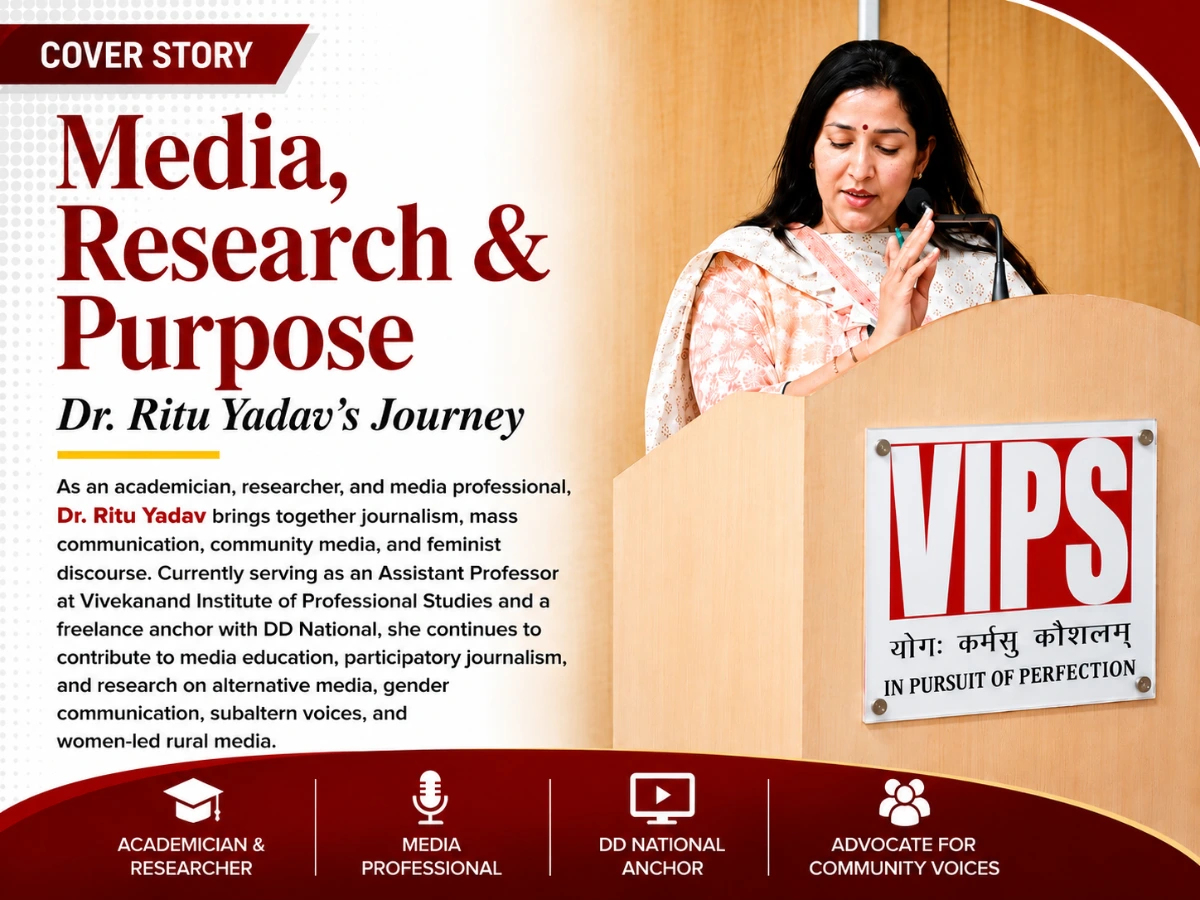
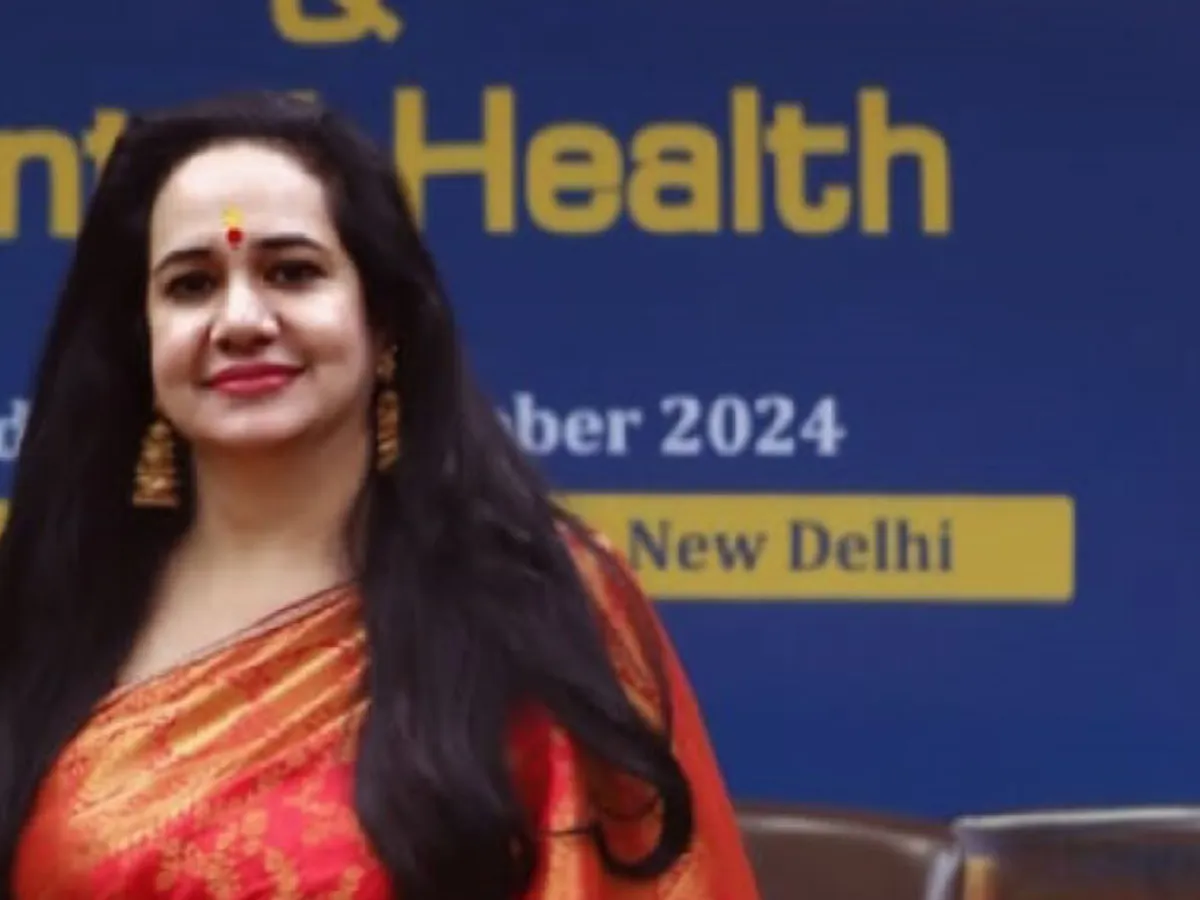
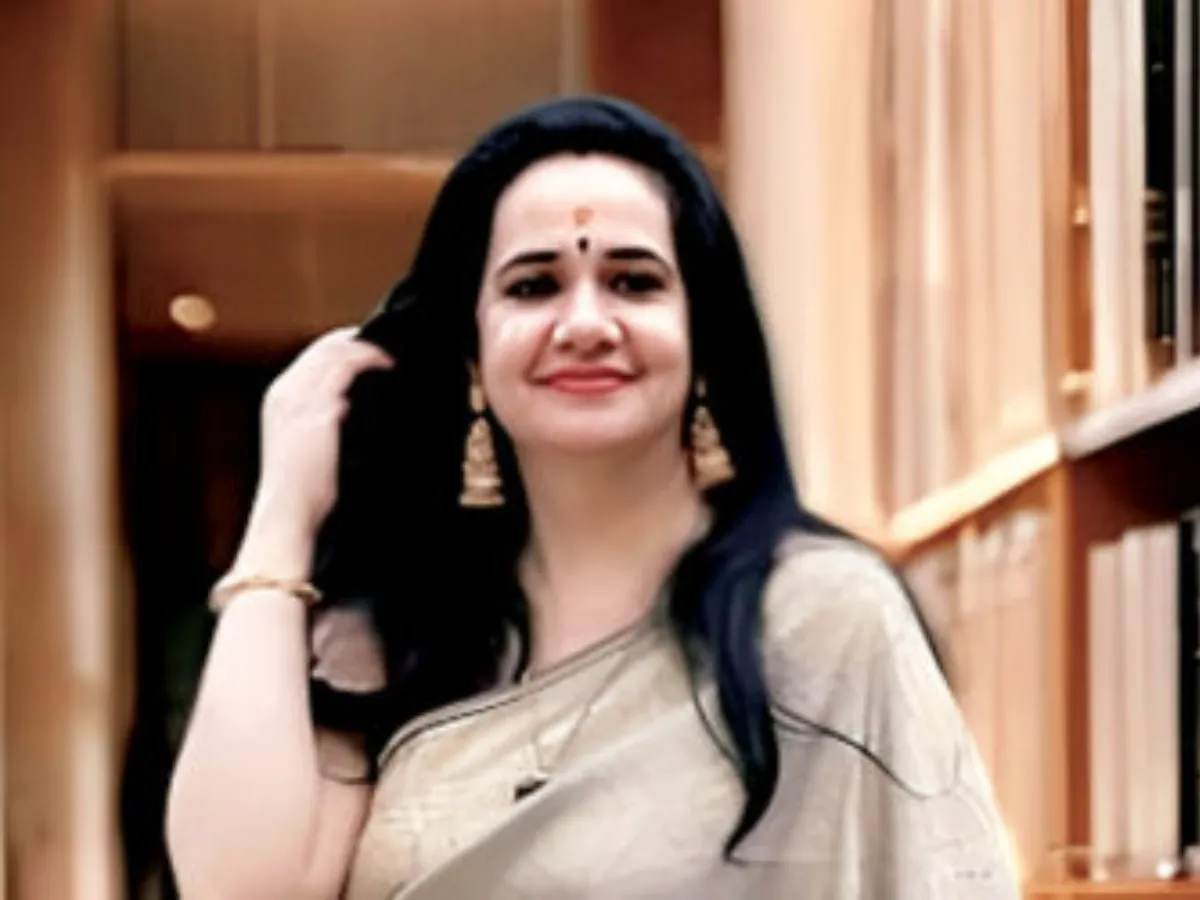
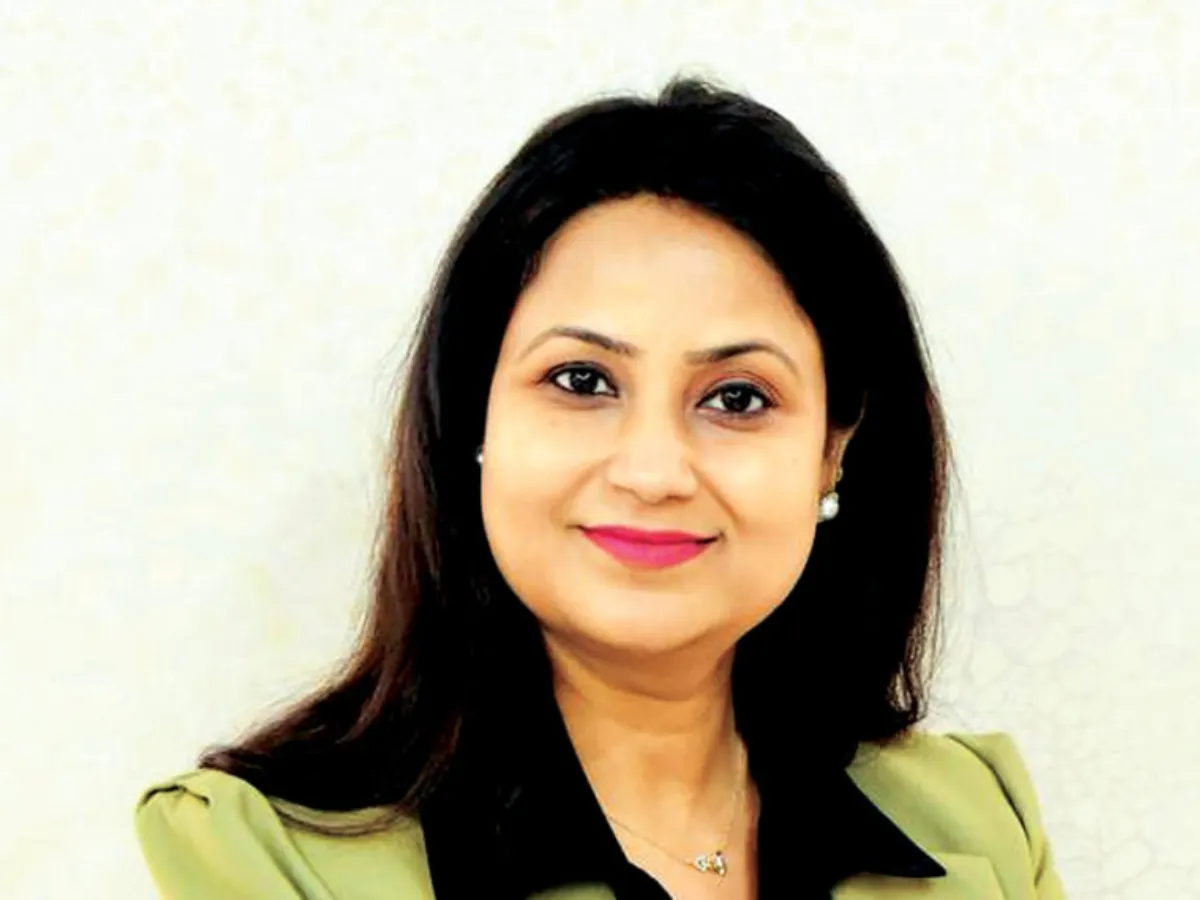










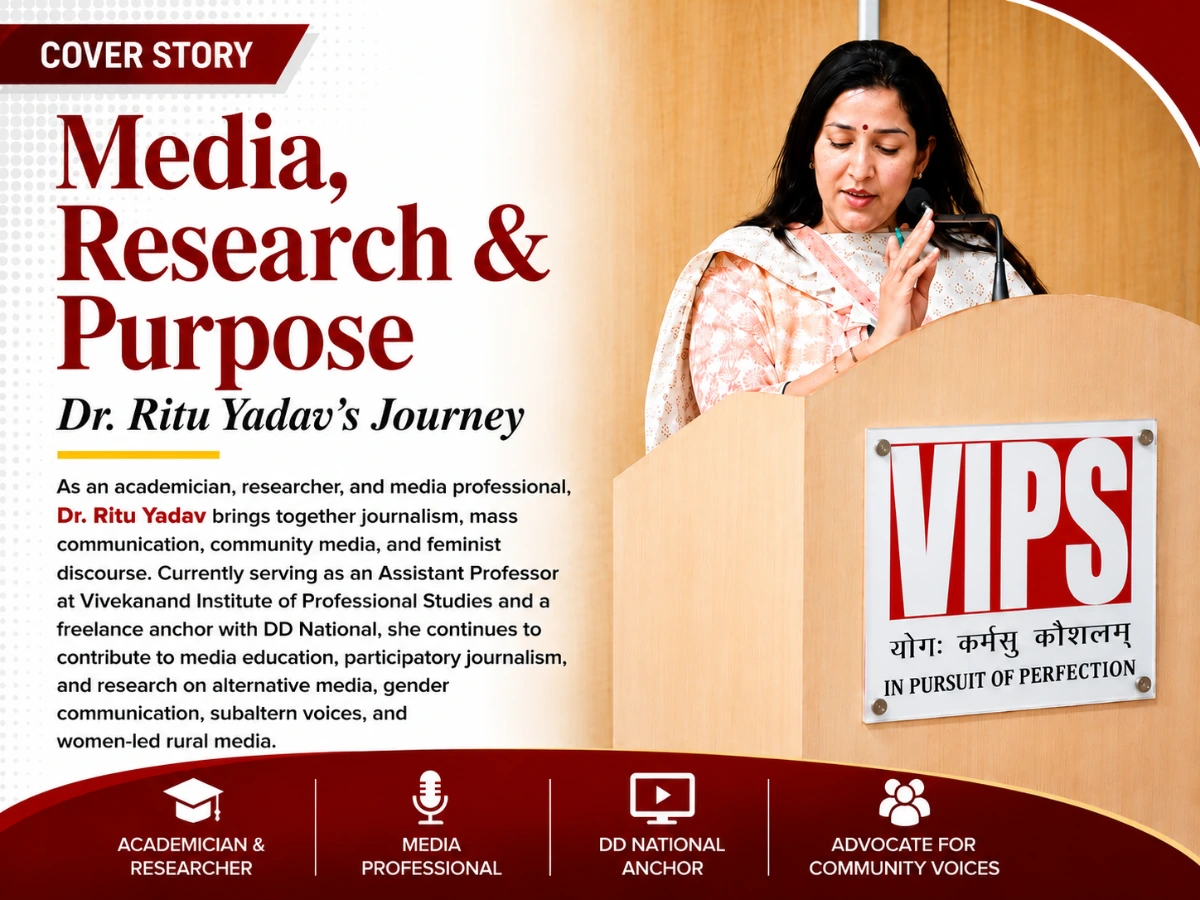
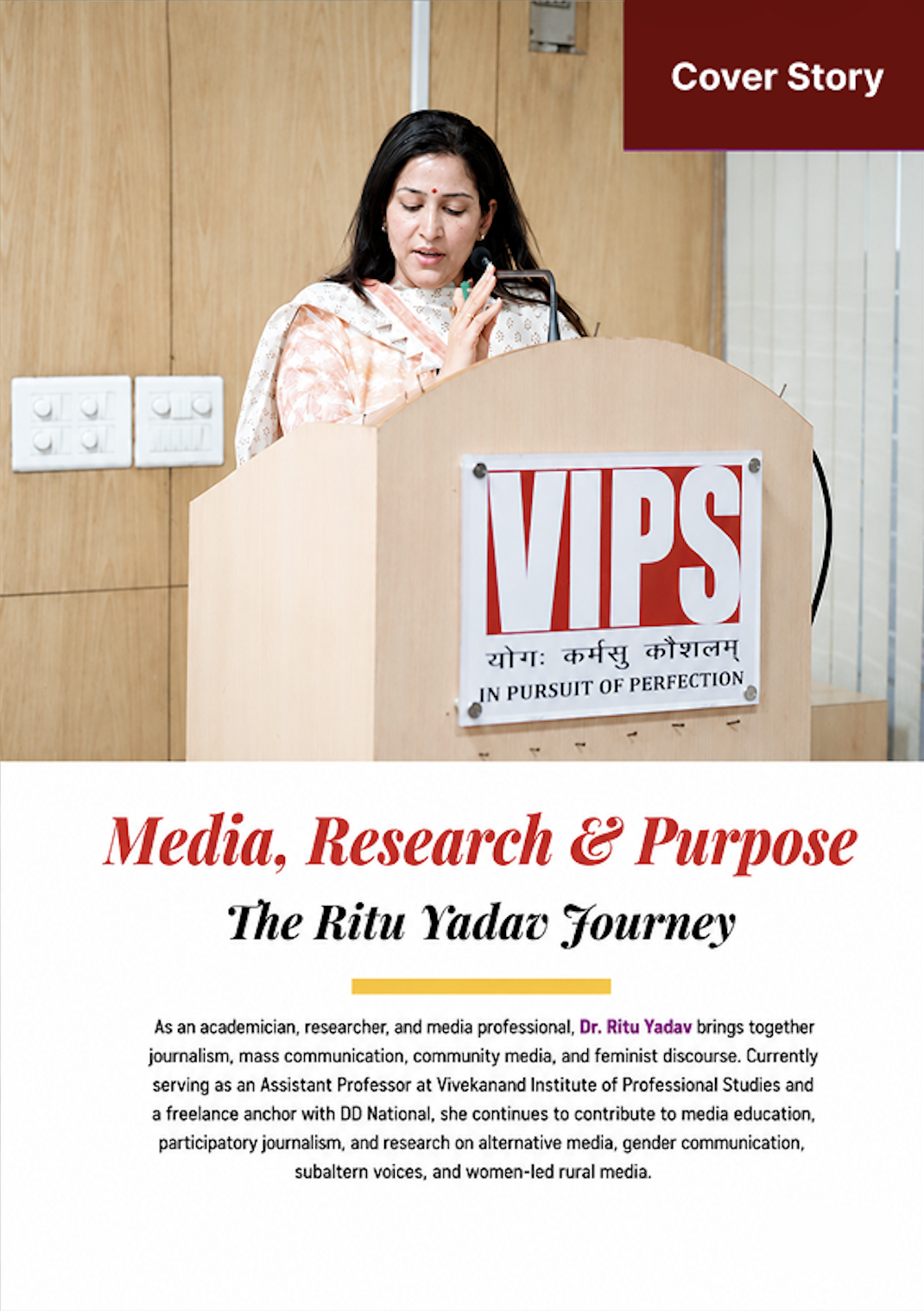
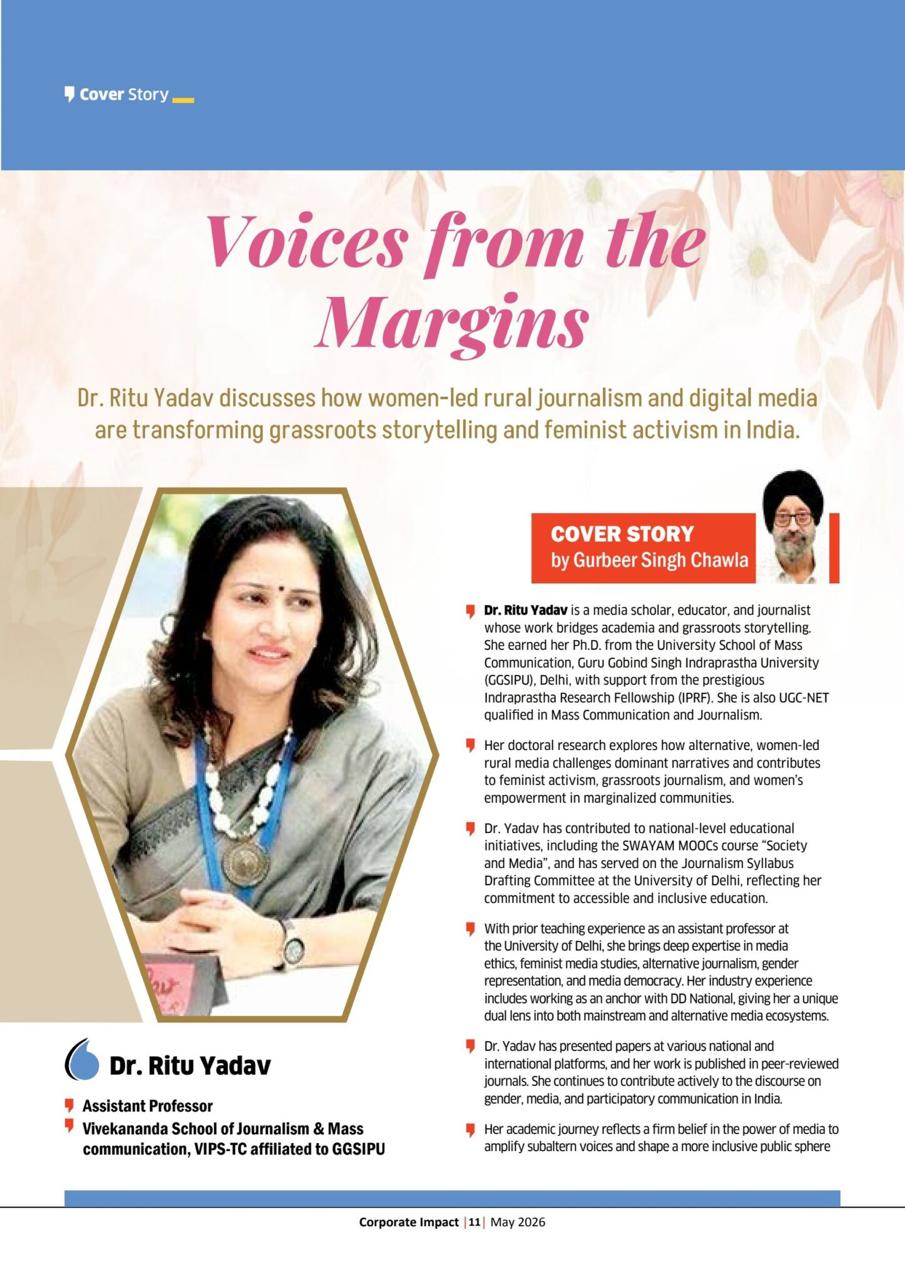
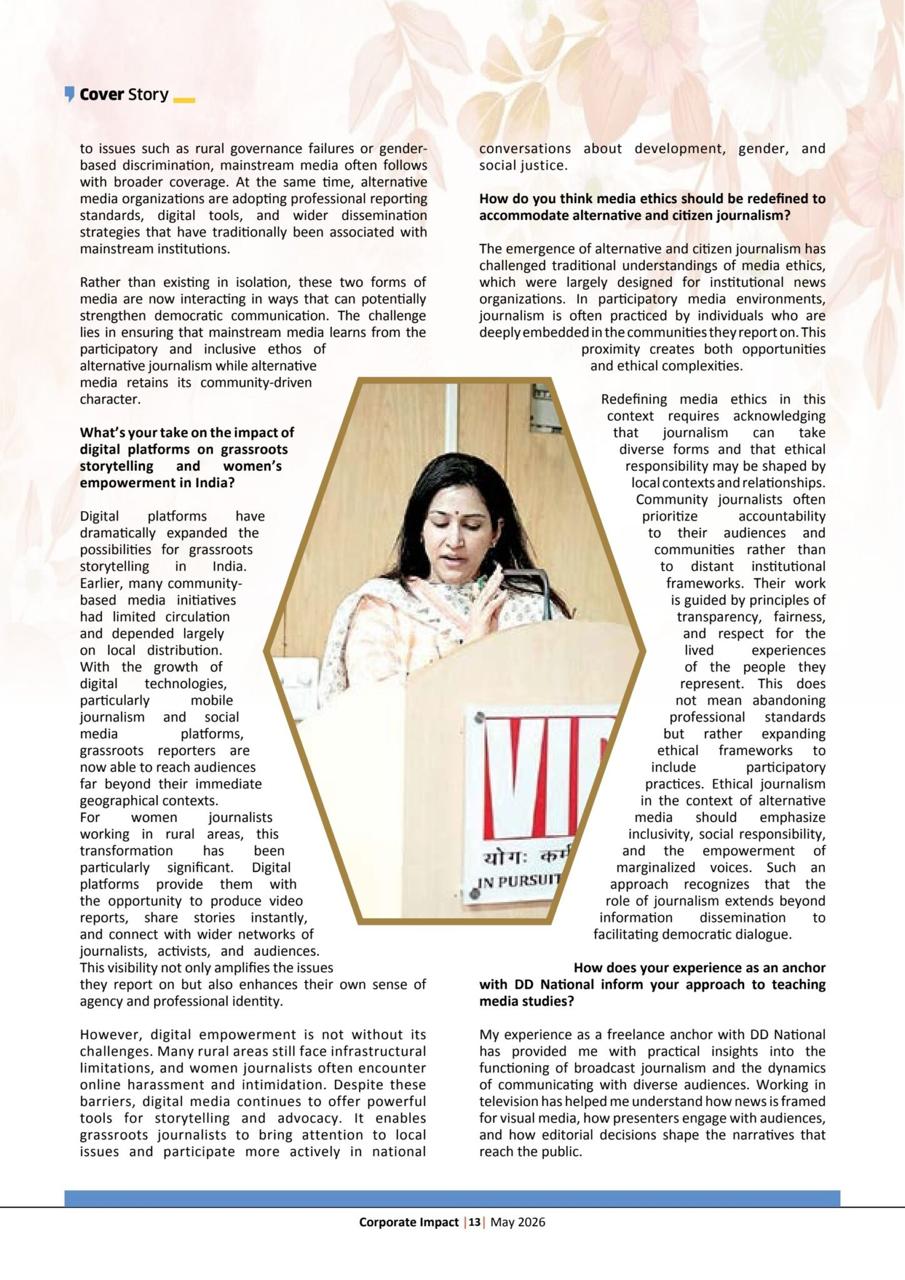
Dr. Ritu Yadav is an academician, researcher, and media professional specializing in journalism, mass communication, community media, and feminist discourse. She is currently serving as an Assistant Professor at Vivekanand Institute of Professional Studies and also works as a freelance anchor with DD National. Her research focuses on alternative media, subaltern voices, gender communication, and participatory journalism. She has published several research papers in reputed journals on media, democracy, development communication, and women-led rural media. Dr. Yadav has also served as an External Examiner at different Central and State Universities, contributing actively to academics, curriculum development, and media education.
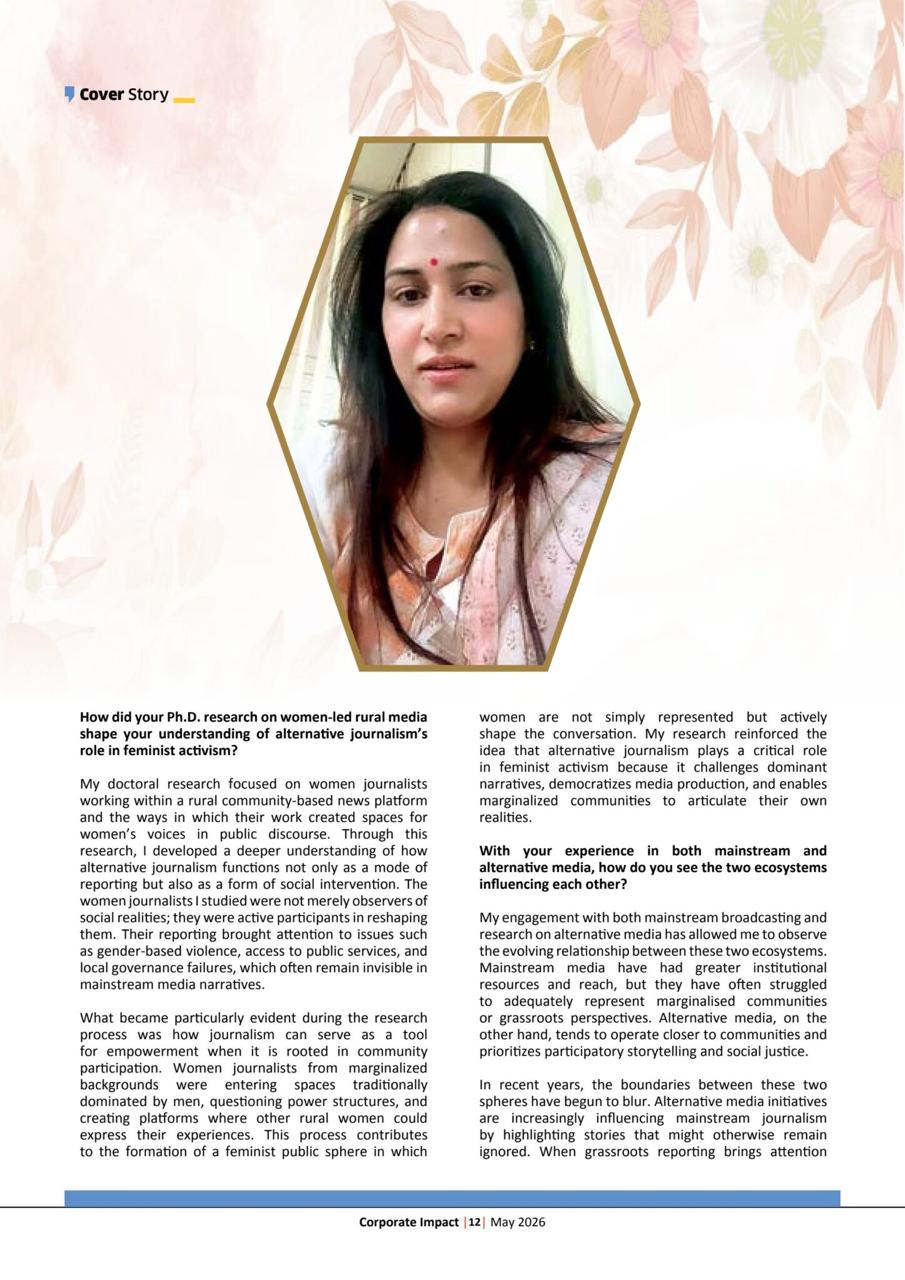
1. How did your Ph.D. research on women-led rural media shape your understanding of alternative journalism’s role in feminist activism?
My doctoral research focused on women journalists working within a rural community-based news platform and the ways in which their work created spaces for women’s voices in public discourse. Through this research, I developed a deeper understanding of how alternative journalism functions not only as a mode of reporting but also as a form of social intervention. The women journalists I studied were not merely observers of social realities; they were active participants in reshaping them. Their reporting brought attention to issues such as gender-based violence, access to public services, and local governance failures, which often remain invisible in mainstream media narratives.
What became particularly evident during the research process was how journalism can serve as a tool for empowerment when it is rooted in community participation. Women journalists from marginalized backgrounds were entering spaces traditionally dominated by men, questioning power structures, and creating platforms where other rural women could express their experiences. This process contributes to the formation of a feminist public sphere in which women are not simply represented but actively shape the conversation. My research reinforced the idea that alternative journalism plays a critical role in feminist activism because it challenges dominant narratives, democratizes media production, and enables marginalized communities to articulate their own realities.
2. With your experience in both mainstream and alternative media, how do you see the two ecosystems influencing each other?
My engagement with both mainstream broadcasting and research on alternative media has allowed me to observe the evolving relationship between these two ecosystems. Mainstream media have had greater institutional resources and reach, but they have often struggled to adequately represent marginalised communities or grassroots perspectives. Alternative media, on the other hand, tends to operate closer to communities and prioritizes participatory storytelling and social justice.
In recent years, the boundaries between these two spheres have begun to blur. Alternative media initiatives are increasingly influencing mainstream journalism by highlighting stories that might otherwise remain ignored. When grassroots reporting brings attention to issues such as rural governance failures or gender-based discrimination, mainstream media often follows with broader coverage. At the same time, alternative media organizations are adopting professional reporting standards, digital tools, and wider dissemination strategies that have traditionally been associated with mainstream institutions.
Rather than existing in isolation, these two forms of media are now interacting in ways that can potentially strengthen democratic communication. The challenge lies in ensuring that mainstream media learns from the participatory and inclusive ethos of alternative journalism while alternative media retains its community-driven character.
3. What’s your take on the impact of digital platforms on grassroots storytelling and women’s empowerment in India?
Digital platforms have dramatically expanded the possibilities for grassroots storytelling in India. Earlier, many community-based media initiatives had limited circulation and depended largely on local distribution. With the growth of digital technologies, particularly mobile journalism and social media platforms, grassroots reporters are now able to reach audiences far beyond their immediate geographical contexts.
For women journalists working in rural areas, this transformation has been particularly significant. Digital platforms provide them with the opportunity to produce video reports, share stories instantly, and connect with wider networks of journalists, activists, and audiences. This visibility not only amplifies the issues they report on but also enhances their own sense of agency and professional identity.
However, digital empowerment is not without its challenges. Many rural areas still face infrastructural limitations, and women journalists often encounter online harassment and intimidation. Despite these barriers, digital media continues to offer powerful tools for storytelling and advocacy. It enables grassroots journalists to bring attention to local issues and participate more actively in national conversations about development, gender, and social justice.
4. How do you think media ethics should be redefined to accommodate alternative and citizen journalism?
The emergence of alternative and citizen journalism has challenged traditional understandings of media ethics, which were largely designed for institutional news organizations. In participatory media environments, journalism is often practiced by individuals who are deeply embedded in the communities they report on. This proximity creates both opportunities and ethical complexities.
Redefining media ethics in this context requires acknowledging that journalism can take diverse forms and that ethical responsibility may be shaped by local contexts and relationships. Community journalists often prioritize accountability to their audiences and communities rather than to distant institutional frameworks. Their work is guided by principles of transparency, fairness, and respect for the lived experiences of the people they represent.
This does not mean abandoning professional standards but rather expanding ethical frameworks to include participatory practices. Ethical journalism in the context of alternative media should emphasize inclusivity, social responsibility, and the empowerment of marginalized voices. Such an approach recognizes that the role of journalism extends beyond information dissemination to facilitating democratic dialogue.
5. Your work highlights the importance of subaltern voices. How can community media do better in amplifying these voices?
My experience as a freelance anchor with DD National has provided me with practical insights into the functioning of broadcast journalism and the dynamics of communicating with diverse audiences. Working in television has helped me understand how news is framed for visual media, how presenters engage with audiences, and how editorial decisions shape the narratives that reach the public.
When I teach media studies, I try to integrate these professional experiences into classroom discussions so that students can connect theoretical concepts with real-world media practices. Students often benefit from understanding how newsroom workflows operate, how stories are structured for broadcast formats, and how ethical considerations influence editorial choices.
This combination of academic research and professional media experience allows me to create a learning environment where students are encouraged to critically examine media systems while also developing practical skills. It helps them appreciate journalism not only as a theoretical field of study but also as a professional practice that carries significant social responsibility.
6. How does your experience as an anchor with DD National inform your approach to teaching media studies?
My experience as a freelance anchor with DD National has provided me with practical insights into the functioning of broadcast journalism and the dynamics of communicating with diverse audiences. Working in television has helped me understand how news is framed for visual media, how presenters engage with audiences, and how editorial decisions shape the narratives that reach the public.
When I teach media studies, I try to integrate these professional experiences into classroom discussions so that students can connect theoretical concepts with real-world media practices. Students often benefit from understanding how newsroom workflows operate, how stories are structured for broadcast formats, and how ethical considerations influence editorial choices.
This combination of academic research and professional media experience allows me to create a learning environment where students are encouraged to critically examine media systems while also developing practical skills. It helps them appreciate journalism not only as a theoretical field of study but also as a professional practice that carries significant social responsibility.
7. In your opinion, what are the key challenges facing feminist media activism in India today?
Feminist media activism in India operates within a complex social and political environment where gender inequalities remain deeply embedded in many institutions, including media organizations themselves. One major challenge is the persistence of patriarchal structures that influence editorial priorities and representation within newsrooms. Even today, women journalists often face barriers in accessing leadership positions and decision-making roles.
Another challenge relates to the sustainability of independent feminist media initiatives. Many alternative platforms operate with limited financial resources and depend on external funding or project-based support. This can make it difficult to maintain long-term operations and expand their reach.
Additionally, the digital environment has created new risks for women journalists and activists. Online harassment, trolling, and gender-based abuse have become common experiences for many individuals who engage in feminist advocacy through media platforms. Despite these challenges, feminist media activism continues to grow, supported by networks of journalists, scholars, and activists who are committed to expanding spaces for gender justice in public discourse.
8. Your research explores the intersection of media and women’s empowerment. What are some promising trends you’ve observed?
One encouraging trend I have observed is the increasing presence of women in community-based journalism and digital storytelling initiatives. Women who were previously excluded from public communication spaces are now actively participating as reporters, editors, and media producers. This shift not only diversifies media representation but also challenges long-standing gender hierarchies in journalism.
Another promising development is the growing recognition of intersectionality in media discourse. Discussions around women’s empowerment are increasingly acknowledging that gender intersects with other factors such as caste, class, and demography. As a result, media narratives are becoming more nuanced and reflective of diverse experiences.
Digital technologies have also opened new avenues for women’s participation in media production. With access to mobile devices and online platforms, women journalists can share their stories without relying solely on traditional media institutions. These developments suggest that the future of media and women’s empowerment will likely involve a combination of grassroots initiatives, digital innovation, and collaborative networks.
9. How do you think policymakers can support alternative media and grassroots journalism initiatives?
Policymakers can play an important role in strengthening alternative media by recognizing its contribution to democratic communication and social inclusion. One of the most significant forms of support would involve expanding digital infrastructure in rural and underserved regions so that grassroots journalists have the technological resources needed to produce and distribute their stories.
Capacity-building initiatives are also essential. Training programs that focus on digital storytelling, ethical journalism, and media literacy can help community journalists enhance their professional skills while maintaining their connection to local contexts.
Furthermore, policymakers could consider establishing funding mechanisms or grant programs that support independent and community-based media initiatives. These platforms often operate with limited resources but play a vital role in amplifying marginalized voices and holding local institutions accountable. By supporting such initiatives, governments can contribute to a more inclusive and participatory media ecosystem.
10. What’s your perspective on the role of social media in shaping narratives around gender and representation?
Social media has transformed the ways in which narratives around gender and representation are constructed and circulated. Unlike traditional media, which often operates through centralized editorial structures, social media platforms allow individuals and communities to share their experiences directly with large audiences without gatekeeping. This has enabled many feminist movements and advocacy campaigns to gain visibility and mobilize support.
At the same time, social media platforms can also reproduce existing inequalities. Women journalists and activists frequently face online harassment, misinformation, and coordinated trolling. These experiences highlight the need for stronger digital literacy initiatives and more effective regulatory frameworks that protect individuals from abuse.
Despite these challenges, social media remains an important space for dialogue and activism. It allows marginalized voices to challenge dominant narratives, build networks of solidarity, and contribute to broader conversations about gender equality and representation.