



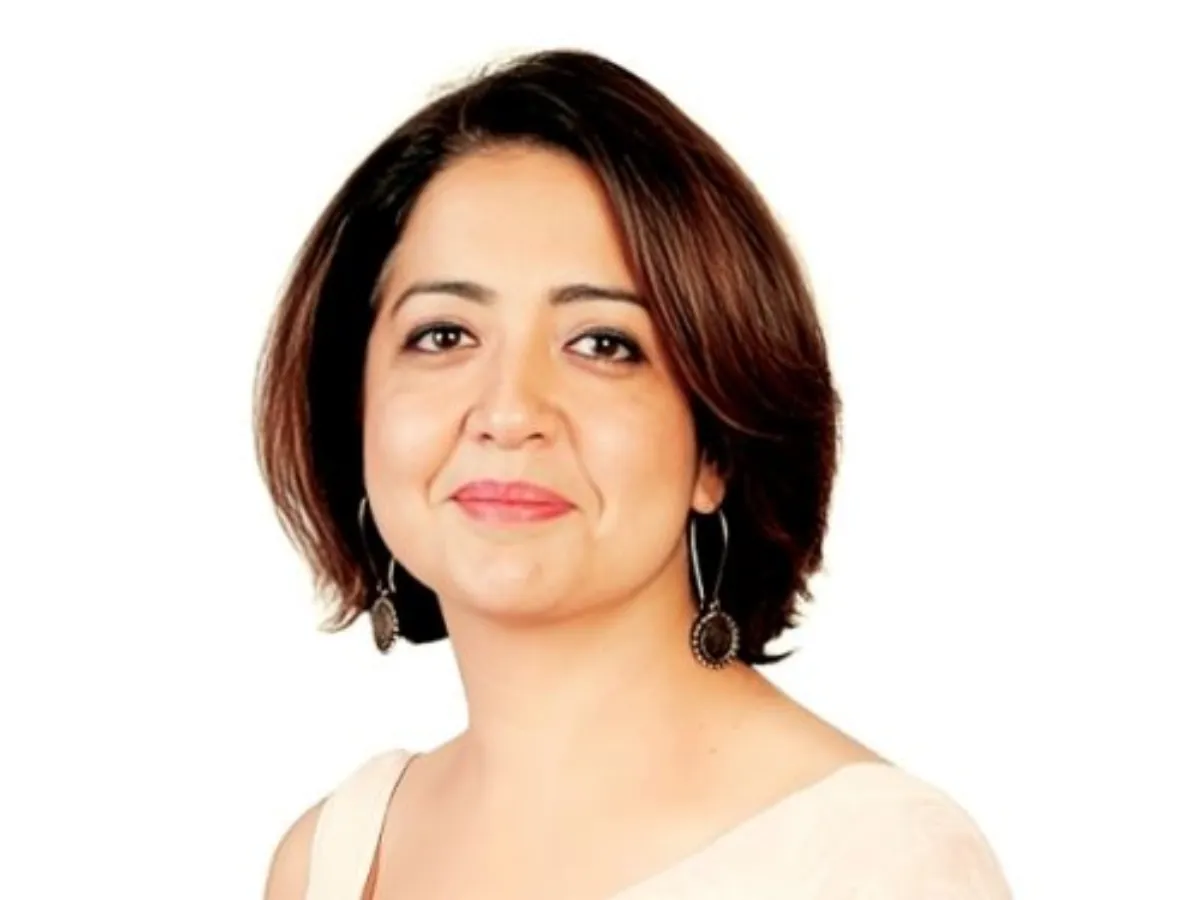












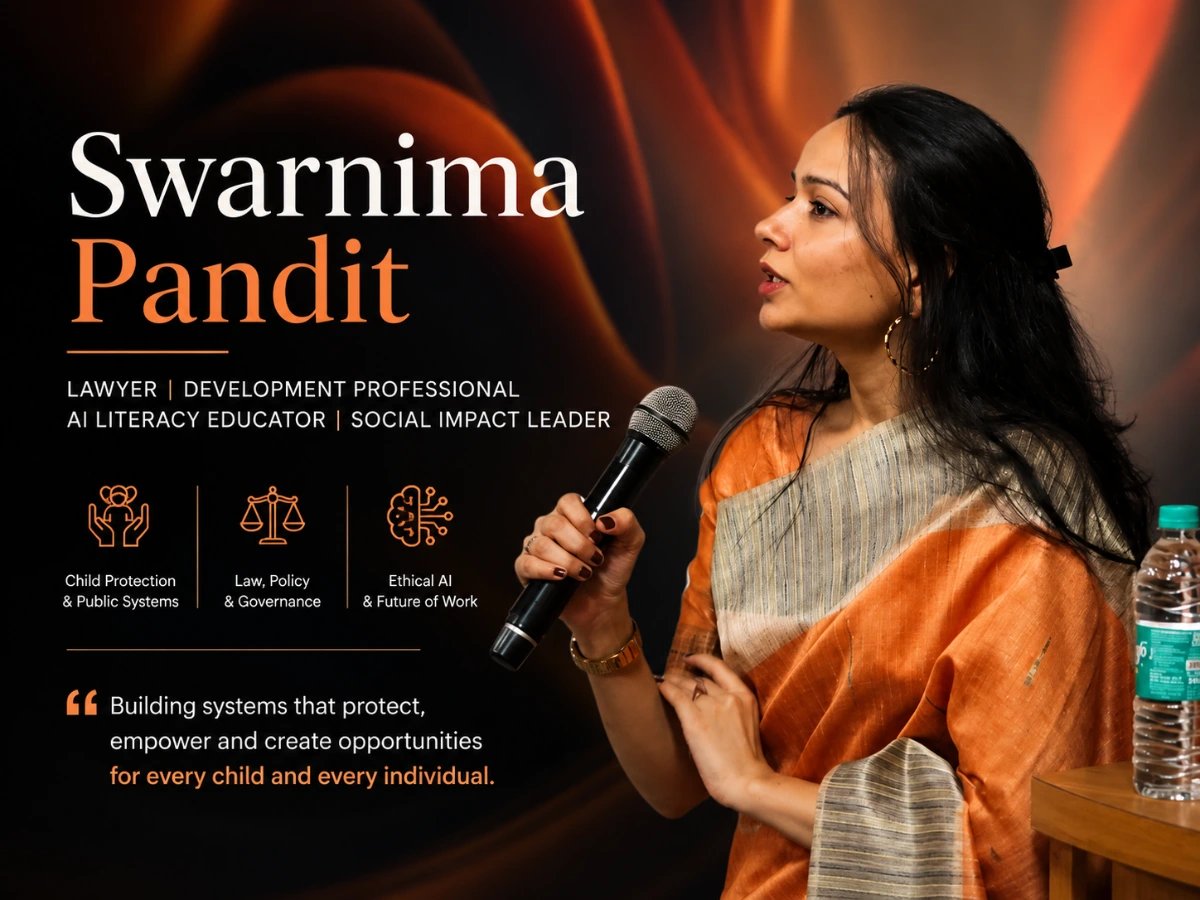











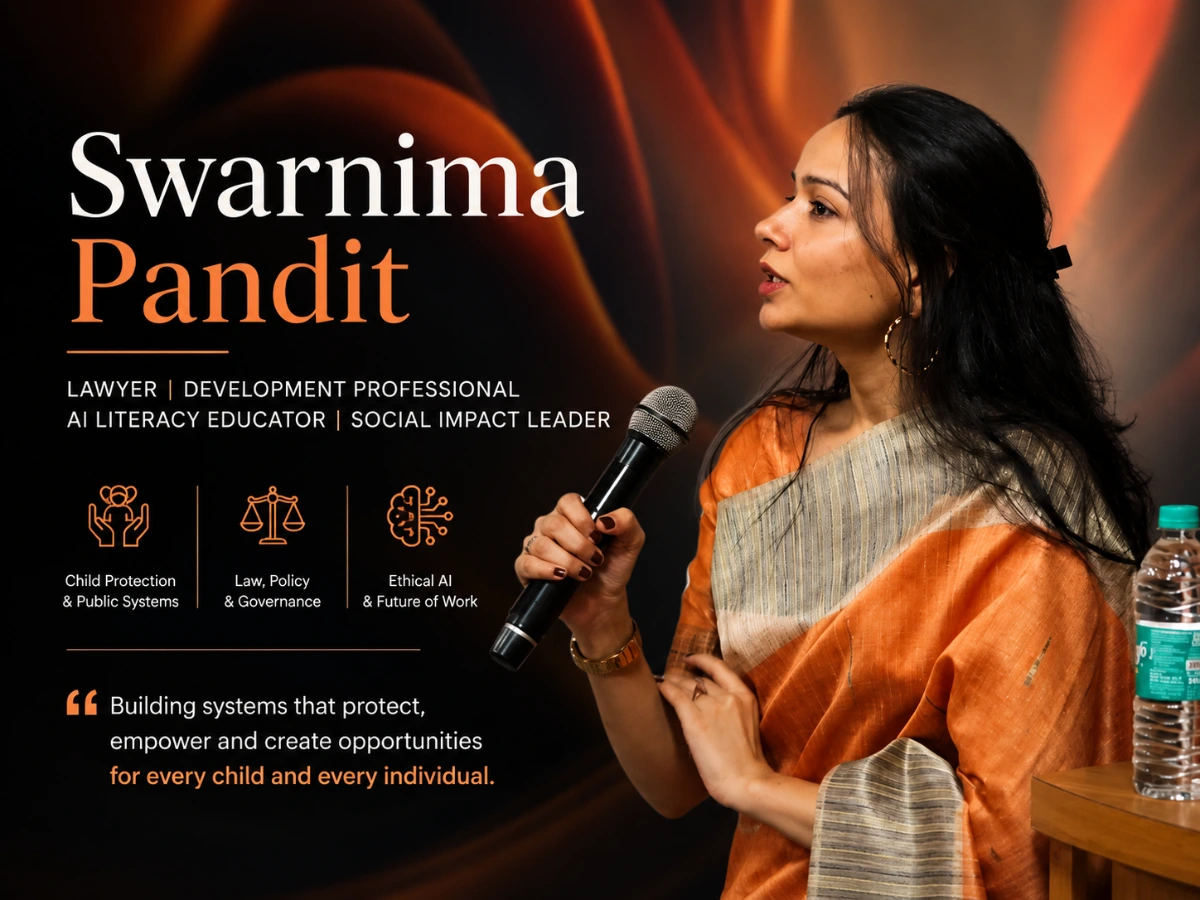
Swarnima Pandit: Making Complex Systems More Accessible, Responsible and Human
Swarnima Pandit is a lawyer, development professional and AI literacy educator with eight years of experience across child protection, public systems and ethical AI. An academic merit rank holder at ILS Law College, Pune, and recipient of academic excellence awards, she has worked with a Rajya Sabha Member of Parliament, Mumbai Police, Project Kalki, and the Government of Maharashtra and UNICEF.
She led the Child Protection team with the Government of Maharashtra, working closely with district administrations and frontline systems. She played a key role in Phirti Pathak, selected by the Government of India as an Innovative Project in 2022 and 2023, and now operational across Maharashtra.
At The Apprentice Project, Swarnima works on AI-enabled learning for underserved children. She has built a 100,000+ audience across platforms who follow her work on AI and careers, using her voice to simplify emerging technology for working professionals and has also mentored 100+ individuals navigating AI-adjacent careers.
1. What pushed you from legal research into frontline child protection and anti-trafficking work?
My shift towards frontline child protection began when I was working with a Member of Parliament in 2020. During that time, I had the opportunity to work closely on policy research around the Medical Termination of Pregnancy Amendment Bill. It was my first serious exposure to women and child-related issues, not just as legal subjects, but as deeply human realities.
As I read reports on unsafe abortions, maternal health, access to healthcare and the consequences faced by women in vulnerable situations, something changed for me. I realised that law and policy are not abstract. Behind every provision, every data point and every gap in implementation, there are real people whose lives are shaped by whether systems work or fail.
What stayed with me most was how vulnerability often travels across generations. When a woman is denied safe healthcare or loses her life because of systemic gaps, the impact does not end with her. It affects families, children and entire support systems. That was when I began to feel drawn towards understanding vulnerability more closely, especially the lives of children who are often left without protection, voice or care.
Around the same time, I came across the work of Project Kalki and their collaboration with the Mumbai Police on child trafficking cases. Moving from legal and policy research into frontline child protection felt like a pivot that came from the heart. I wanted to understand what justice looked like beyond paper, beyond legislation and beyond institutions. I wanted to be closer to the realities that policy is meant to serve.
2. Working on gender-policy analysis in Rajya Sabha is very different from assisting Mumbai Police in rescue operations. What did those field experiences teach you about gaps between policy intent and ground reality?
My work in Parliament showed me how policy is built through research, evidence and legal reasoning. But my work with the Mumbai Police showed me what happens when that policy meets fear, trauma, poverty and institutional constraints on the ground. That contrast changed me. It made me realise that justice cannot live only in legislation or reports. It has to survive implementation.
On paper, systems can look linear. There is a law, a protocol, a rescue process and a rehabilitation pathway. But on the ground, every step is layered with human realities. A child may be frightened, a family may be complicit or helpless, institutions may be overburdened, and frontline workers may be navigating several constraints at the same time.
Rehabilitation is not a checklist. It is a deeply sensitive process that involves trust, trauma, safety, dignity and long-term care. That experience taught me that governance cannot only be designed from the top down. Policy may provide structure, but implementation requires empathy, capacity and context.
The biggest gap I saw was system capacity. In India, we often design ambitious policies, but we do not always invest enough in the people and institutions responsible for implementing them. If frontline systems are not trained, supported and resourced, even the best policies can struggle to deliver justice.
3. You helped take Phirti Pathak from a pilot to a state-wide Government Resolution with Central funding. What was the toughest part of translating a field insight into a government-recognised, scalable system?
The toughest part was translating a very fluid, human problem into a system that government could recognise, fund and scale without losing sight of the child.
Children in street situations are among the most vulnerable children in our cities. Many are out of the education system, at risk of trafficking, exposed to unsafe environments, and often without consistent access to nutrition, counselling or care. But they are also not a static population. They move across locations, many live with their families, and their realities cannot always be addressed through conventional institutional models.
The idea behind Phirti Pathak was to create a mobile, child-centred response. Instead of immediately separating children from their families or expecting them to come to a fixed centre, the model placed a mobile van near identified hotspots. The van could provide educational support, psychosocial counselling and nutritional support while remaining close to where children actually were.
The most difficult part was identification and continuity. How do you identify children who may not stay in the same place every day? How do you ensure they continue receiving support? How do you build a rehabilitation pathway that is sensitive to family realities, child safety, district capacity and long-term protection? These were not simple administrative questions. They required trust, coordination and constant follow-up.
Another major challenge was bringing different stakeholders onto the same page. The government, district administration, local NGOs, frontline workers and child protection systems all had to align around a shared vision. Sustaining that momentum was not easy, especially because district-level capacity is often stretched. But that is also what made the work meaningful. It was not just about designing a project. It was about building the conditions for the project to actually work.
When Phirti Pathak was selected by the Government of India as an Innovative Project in 2022 and piloted across six districts of Maharashtra, it felt deeply validating. When it was selected again in 2023 and received further support, it showed that the model had the potential to move beyond a pilot. The Government of Maharashtra later issued a Government Resolution based on the intervention, and today Phirti Pathak is operational across Maharashtra.
This work was also acknowledged through an appreciation letter from the Hon’ble Principal Secretary, Women and Child Development Department, Government of Maharashtra, recognising my contributions during COVID-19 and towards strengthening Phirti Pathak as a child-protection intervention.
For me, that journey was both humbling and personal. I had seen the idea from its early stages, and to see it become a state-wide government-backed intervention was a reminder of why public systems matter. The fact that it now operates across Maharashtra, including my hometown Nagpur, makes the impact even more personal. It showed me that when field realities are listened to carefully, they can become policy, funding and systems that reach children who are otherwise too easily left behind.
4. As State Program Officer with the Government of Maharashtra and UNICEF, you led vulnerability mapping and coordinated across WCD, education, districts and CSR. What is one thing most people misunderstand about making public systems actually work for children?
It was truly a privilege to observe and contribute to government systems from close quarters at a relatively young age. One thing most people misunderstand about public systems is the time they take to move.
From the outside, it is easy to see that time as delay. But when I worked within the system, I realised that many important decisions pass through several layers of accountability. Multiple officers examine the issue, assess risks, consider implementation challenges, think through district realities and ensure that a decision can stand the test of public responsibility. What may look like delay from the outside is often a cycle of caution, accountability and collective decision-making.
Of course, public systems can and should become faster and more responsive. But my experience taught me that when decisions affect vulnerable children, speed cannot be the only measure of effectiveness. Responsibility, sustainability and implementation capacity matter just as much.
The other thing I learned is that making public systems work is rarely about one department acting alone. It is about mapping different stakeholder priorities and bringing them together. In my work across Women and Child Development, districts and CSR partners, I learned that each stakeholder comes with a different mandate, language and incentive. The work is to understand those priorities and find the point where they can meet in service of the child.
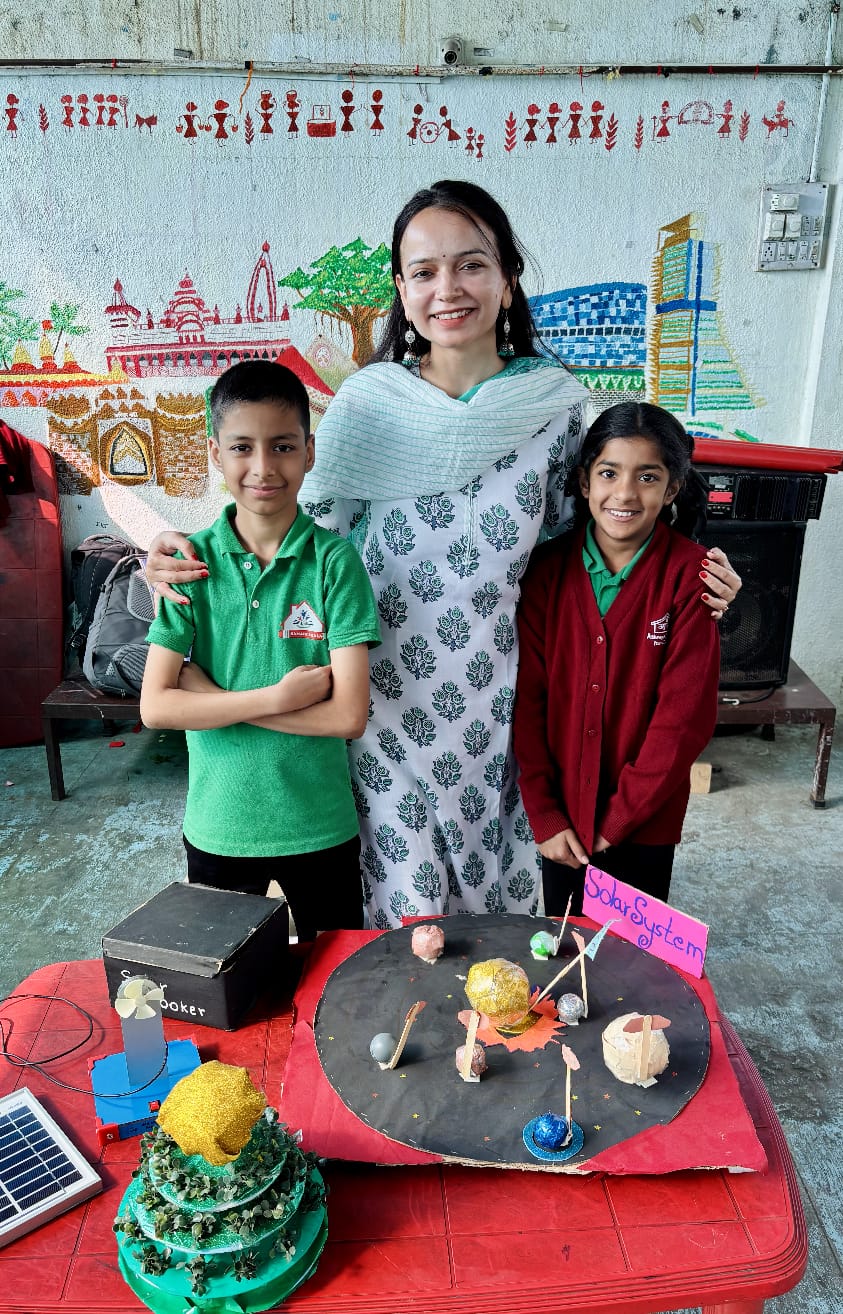
5. Your anti-trafficking work emphasised long-term dignity, not just rescue. How do you design programmes that avoid re-traumatising victims while still meeting institutional metrics?
One of the most important things I learned in anti-trafficking work is that rescue is only the beginning. Children who have been rescued, or children who are at risk of trafficking, remain deeply vulnerable even after they enter rehabilitation systems. That stage requires immense sensitivity because the child is still processing fear, trauma, uncertainty and often a loss of trust in adults and institutions.
In 2021, I visited child care institutions and interacted closely with children who were in rehabilitation. I also engaged with Child Welfare Committees to understand their perspective and the complexity of decisions they have to make. Those experiences taught me that designing programmes for vulnerable children cannot only be about compliance, reporting or institutional targets. It has to begin with dignity.
For me, dignity means not constantly reducing a child’s identity to what happened to them. A child should not have to keep reliving the worst incident of their life in every conversation, form or programme. Trauma-informed programming means acknowledging what they have experienced, but also creating space for them to be seen for their interests, strengths, dreams and potential.
I remember interacting with a girl in Mumbai who had been rescued and was extremely passionate about painting. Whenever I met her, I would speak to her about her drawings, what she was creating, and how she imagined her art in the future. For me, that was not a small conversation. It was a way of gently shifting the focus from trauma to possibility, from victimhood to voice, from survival to independence.
I also had the opportunity to lead a survivor-leadership programme, where the idea was to help girls and women in rehabilitation see themselves not only as recipients of support, but as people with agency, voice and leadership. The purpose was to create a programme that allowed them to imagine a future with dignity, confidence and self-belief.
Institutional metrics are important because safety, documentation, counselling, education and rehabilitation outcomes must be tracked. But the challenge is to ensure that metrics do not make the process mechanical or extractive. A good programme must protect the child, meet institutional requirements and still preserve the child’s dignity. That balance, for me, is at the heart of responsible rehabilitation.
6. You say you approach AI not just as a career opportunity but as a public-interest issue. How should ethical AI adoption look different in child protection or education versus corporate tech?
I see AI as a public-interest issue because it is no longer just a technology question. It is a question of access, rights, opportunity and power. AI is already shaping how people learn, work, access services and make decisions. With PwC estimating that AI could contribute US$15.7 trillion to the global economy by 2030, its societal impact will be profound, especially in a country like India where scale, diversity and inequality coexist.
For me, ethical AI is not just about efficiency or innovation. We must ask: Who is represented in the data? Who is excluded? Who benefits? And who bears the risk when systems fail?
These questions are particularly important in child protection and education because they involve vulnerable populations and sensitive data. While an AI error in a corporate setting may affect productivity, in education it can influence a child’s learning journey, reinforce bias or compromise privacy.
The risks are real. AI systems can reproduce existing inequalities when trained on incomplete or unrepresentative data, excluding children from marginalised communities, non-dominant language groups or those with limited digital access. UNESCO’s 2023 global survey found that fewer than 10% of schools and universities had formal guidance on generative AI, despite its rapid adoption.
The digital divide further compounds these challenges. UNICEF and the International Telecommunication Union reported during the COVID-19 pandemic that around two-thirds of school-age children globally lacked internet access at home, demonstrating how technology can widen inequalities when access is uneven.
Privacy is another major concern. UNICEF’s policy guidance on AI for children highlights that children require stronger protections because they often cannot fully understand or consent to how their data is collected and used. Without safeguards, AI can expose them to risks such as profiling, surveillance and misuse of personal information.
That is why AI literacy and ethical guardrails must go hand in hand. Introducing AI tools is not enough. Teachers, parents, frontline workers, children and policymakers must understand both their potential and limitations. Human judgment and accountability must remain central, especially when children’s welfare is involved.
In education and child protection, AI adoption should be deliberate, transparent and accountable, with strong data protection, bias checks, child-safety principles and meaningful human oversight. Ultimately, I believe responsible AI is about ensuring that technology expands equity, dignity and opportunity rather than reinforcing existing inequalities.
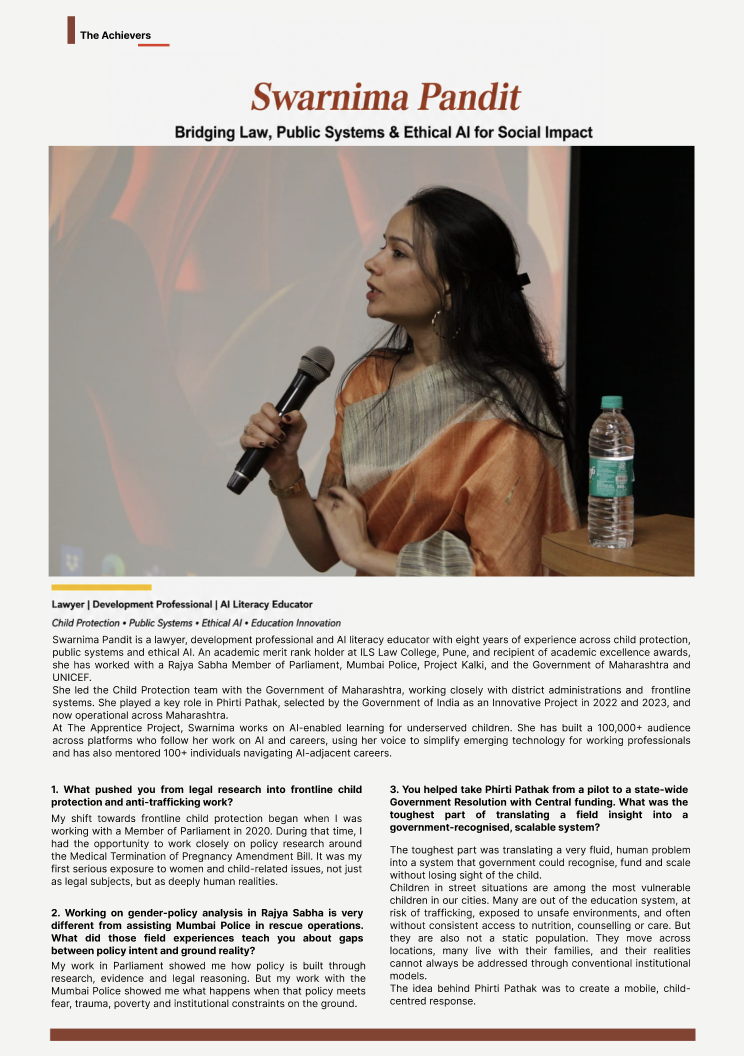
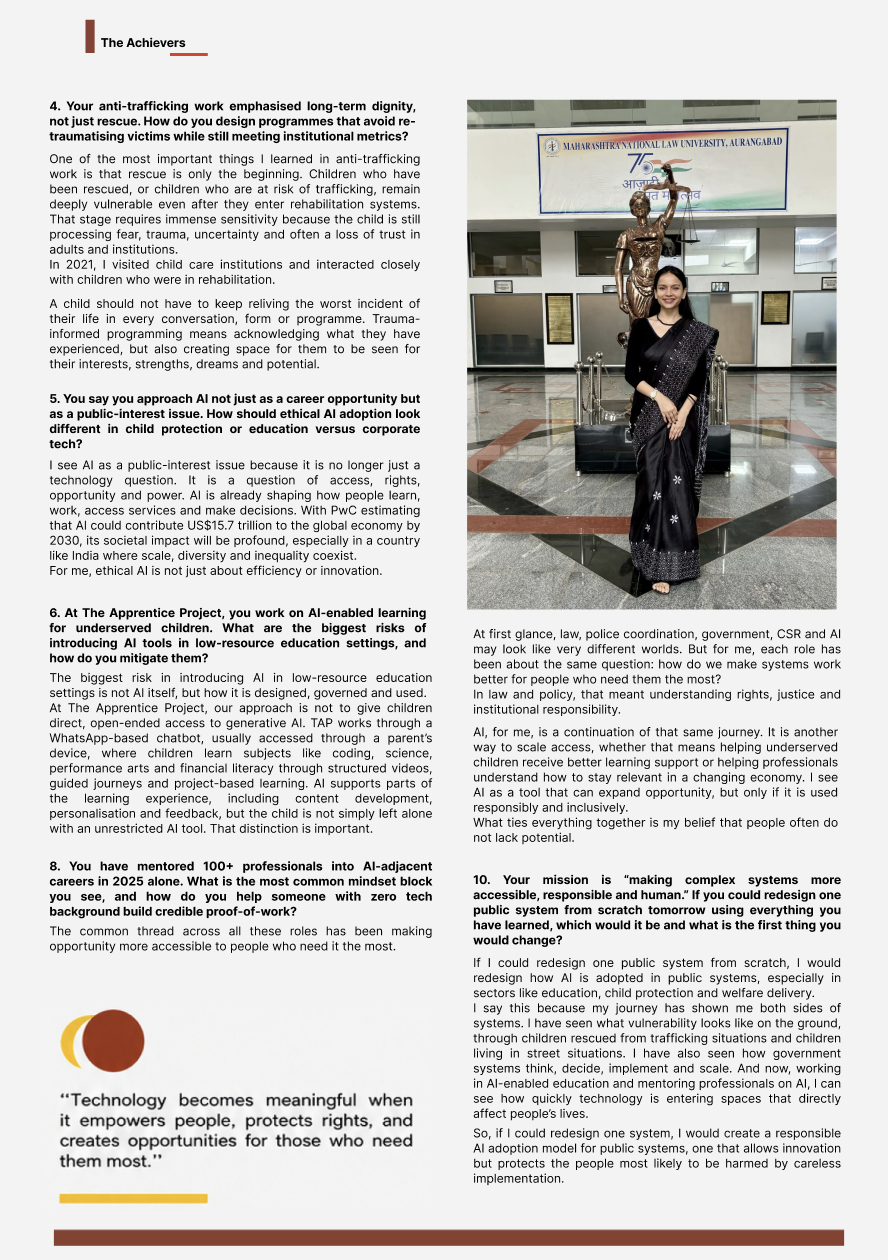
7. At The Apprentice Project, you work on AI-enabled learning for underserved children. What are the biggest risks of introducing AI tools in low-resource education settings, and how do you mitigate them?
The biggest risk in introducing AI in low-resource education settings is not AI itself, but how it is designed, governed and used.
At The Apprentice Project, our approach is not to give children direct, open-ended access to generative AI. TAP works through a WhatsApp-based chatbot, usually accessed through a parent’s device, where children learn subjects like coding, science, performance arts and financial literacy through structured videos, guided journeys and project-based learning. AI supports parts of the learning experience, including content development, personalisation and feedback, but the child is not simply left alone with an unrestricted AI tool.
That distinction is important. In low-resource settings, many children may be first-generation digital learners. They may not always have the context to know when AI is wrong, biased or inappropriate. There are also serious questions around privacy, consent, data protection, language, access and unequal digital exposure. If AI is introduced without guardrails, it can widen the very inequities it is supposed to solve.
For me, mitigation starts with design. AI in education should be structured, age-appropriate and purpose-led. It should support learning, not replace teachers, caregivers or human judgment. The learning pathway should be clear, the content should be reviewed, and any AI-generated feedback should be used to strengthen the child’s learning experience rather than label or limit the child.
8. You have mentored 100+ professionals into AI-adjacent careers in 2025 alone. What is the most common mindset block you see, and how do you help someone with zero tech background build credible proof-of-work?
After mentoring 100+ professionals and reaching over 10 million people through my educational videos on AI and careers, I have seen one fear come up repeatedly: “I am not from a tech background, so can I really build a career around AI?”
I understand where that fear comes from. For many people, AI still feels like something only engineers, coders or data scientists can access. But my experience has taught me that AI is no longer limited to technical roles. It is becoming an added layer across almost every profession. Whether someone works in law, HR, marketing, education, consulting, operations, policy or communications, there are parts of their work that can be made more efficient, more strategic or more scalable through AI.
The data supports this shift. According to Microsoft and LinkedIn’s 2024 Work Trend Index, 75% of knowledge workers globally are already using AI at work. The World Economic Forum’s Future of Jobs Report 2025 estimates that 39% of workers’ core skills will change by 2030, while AI and information-processing skills are among the fastest-growing capabilities employers are seeking. These trends suggest that AI is becoming a workplace skill rather than a specialist discipline reserved for technical professionals.
The first thing I help professionals understand is that their non-technical background is not a weakness. It is often their domain advantage. A lawyer understands legal risk. A teacher understands learning gaps. An HR professional understands people processes. A communications professional understands messaging. AI becomes powerful when it is applied to a real-world domain problem.
For proof-of-work, I encourage people to start where they already are. They can begin by identifying one repetitive workflow in their current role and using simple automation tools such as Zapier, Make or n8n to improve it. For example, they can automate reporting, build a content research workflow, create a client onboarding system, design a recruitment tracker or create an AI-assisted knowledge base for their team.
The second layer is building agents. Today, many AI platforms allow users to create simple AI agents using natural language instructions, often with little or no coding required. That changes the game for non-technical professionals. A policy professional can build a policy research assistant. A fundraiser can build a donor prospecting agent. A recruiter can build a CV-screening workflow. A content creator can build a research and scripting assistant. These become credible proof-of-work because they show that the person is not just learning AI theoretically, but applying it to solve real problems.
I always tell people: do not start with the question, “How do I become technical enough?” Start with, “What problem do I understand deeply, and how can AI help me solve it better?”
That shift changes everything. It moves people from fear to experimentation. And once they build even one useful workflow or agent, they begin to see that AI is not here only for people who can code. It is here for people who can think clearly, understand problems deeply and use technology responsibly to create better outcomes.
.jpeg)
9. You have worked across law, police coordination, government, CSR and now AI. What is the common thread that ties all these roles together for you?
The common thread across all these roles has been making opportunity more accessible to people who need it the most.
At first glance, law, police coordination, government, CSR and AI may look like very different worlds. But for me, each role has been about the same question: how do we make systems work better for people who need them the most?
In law and policy, that meant understanding rights, justice and institutional responsibility. In anti-trafficking work, it meant supporting children through rescue and rehabilitation, and recognising that dignity must remain central even in the most difficult situations. In government, it meant working through public systems to create interventions that could move beyond individual cases and reach children at scale. In CSR and partnerships, it meant bringing different stakeholders together so resources could reach communities more meaningfully.
AI, for me, is a continuation of that same journey. It is another way to scale access, whether that means helping underserved children receive better learning support or helping professionals understand how to stay relevant in a changing economy. I see AI as a tool that can expand opportunity, but only if it is used responsibly and inclusively.
What ties everything together is my belief that people often do not lack potential. They lack access, support, systems and sometimes someone who can help them see what is possible. Whether I am working with children in vulnerable situations, government systems, nonprofit partners or professionals trying to transition into AI, the deeper purpose remains the same: to help people move closer to their highest potential.
For me, impact is most meaningful when it is both human and systemic. It should change individual lives, but it should also strengthen the systems around them so that the change can last.
10. Your mission is “making complex systems more accessible, responsible and human.” If you could redesign one public system from scratch tomorrow using everything you have learned, which would it be and what is the first thing you would change?
If I could redesign one public system from scratch, I would redesign how AI is adopted in public systems, especially in sectors like education, child protection and welfare delivery.
I say this because my journey has shown me both sides of systems. I have seen what vulnerability looks like on the ground, through children rescued from trafficking situations and children living in street situations. I have also seen how government systems think, decide, implement and scale. And now, working in AI-enabled education and mentoring professionals on AI, I can see how quickly technology is entering spaces that directly affect people’s lives.
The first thing I would change is that ethical AI would not be treated as an afterthought. It would be built into public technology from the design stage itself.
For me, ethical AI in public systems should begin with a simple question: if this system makes a mistake, who carries the cost? In corporate settings, a flawed AI tool may affect efficiency or revenue. But in education, child protection or welfare, a flawed system can affect a child’s learning pathway, a family’s access to support, or how vulnerability is identified and responded to.
That is why I would build a public AI governance framework that is practical, not just theoretical. It would include strong data protection, child-safety standards, bias checks, human oversight, consent protocols, grievance redressal and clear accountability when AI tools are used in decision-making or service delivery.
I would also make AI literacy a core part of this system. It is not enough for policymakers or technology vendors to understand AI. Teachers, frontline workers, government officers, parents and communities also need to understand what AI can do, what it cannot do, and where human judgment must remain central.
My experience in child protection has taught me that vulnerable communities should never become testing grounds for poorly governed innovation. Technology should not extract more data from them without giving them more dignity, access or agency in return.
So, if I could redesign one system, I would create a responsible AI adoption model for public systems, one that allows innovation but protects the people most likely to be harmed by careless implementation.
For me, the future is not AI versus human systems. The future is whether we can build AI-enabled systems that are more humane, more accountable and more accessible than the systems we have today.