


























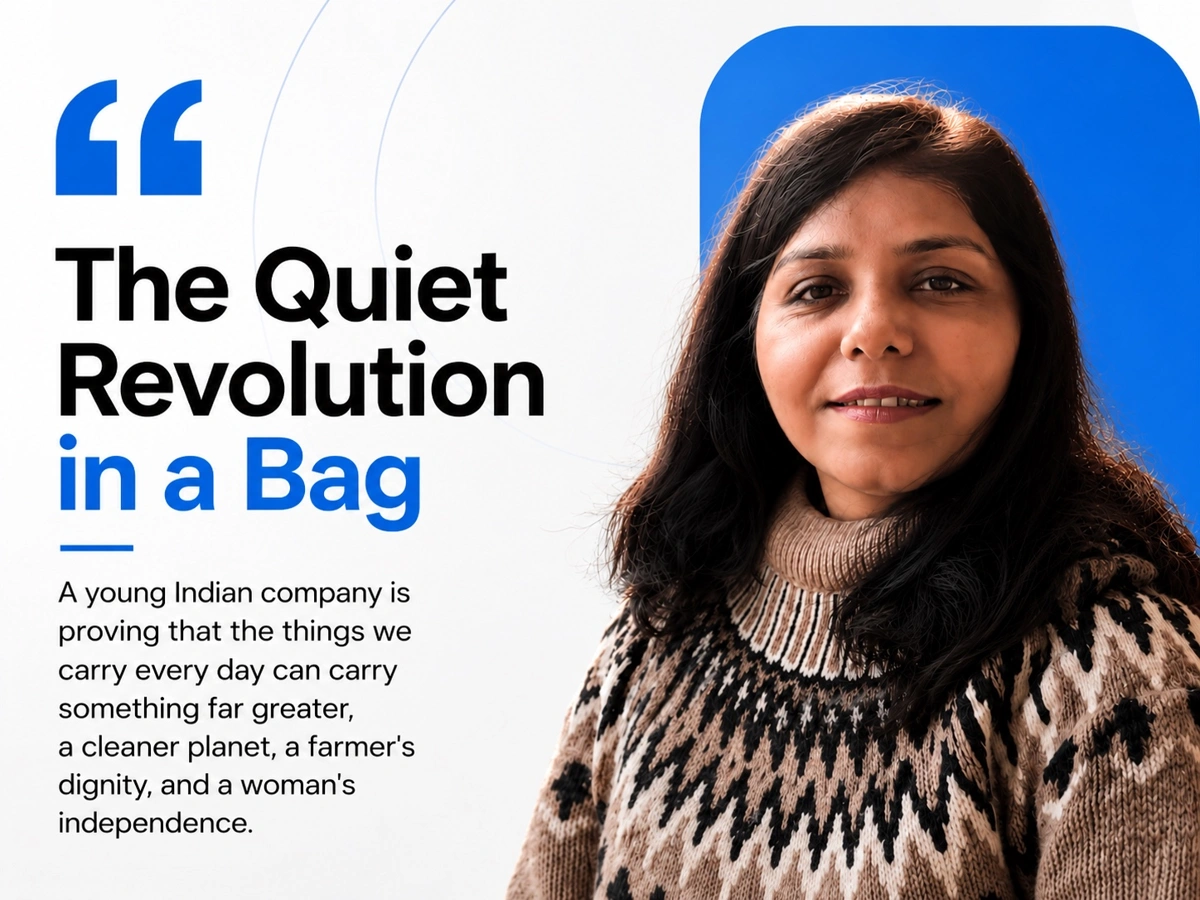









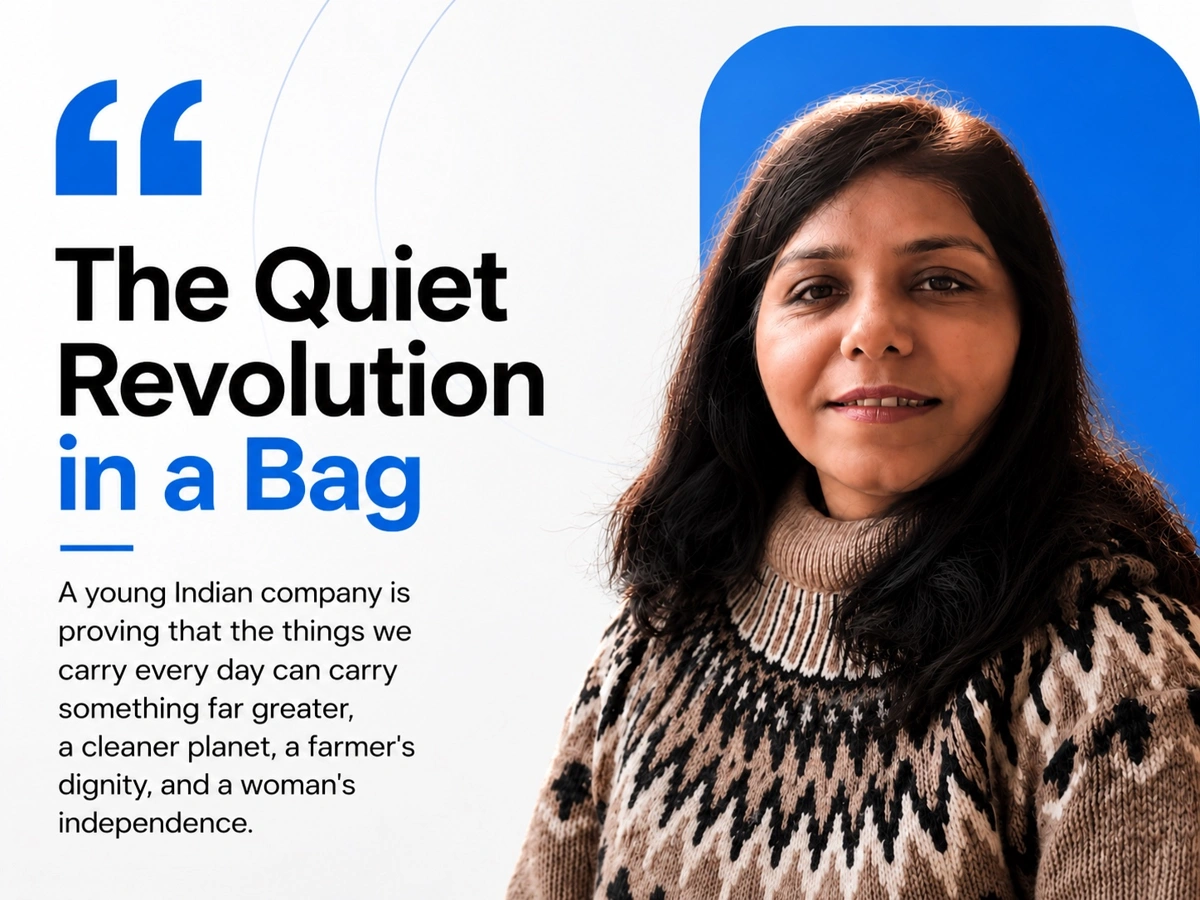
The Quiet Revolution in a Bag
A young Indian company is proving that the things we carry every day can carry something far greater, a cleaner planet, a farmer's dignity, and a woman's independence. Corporate Impact profiles SriJeevanam.
In a village in rural Uttar Pradesh, a woman threads natural fibre through her fingers with the ease of someone who has done it a thousand times. She is making a bag. It is unremarkable work to watch until you understand everything it holds. The raw material in her hands comes from nature, nothing synthetic, nothing Animal derived. The income from her labour will pay her children's school fees. And the finished product will travel hundreds of kilometres to be held by an executive who may never know her name.
This is the supply chain of SriJeevanam — and it runs in the exact opposite direction of almost everything else in the gifting industry.
Where it began
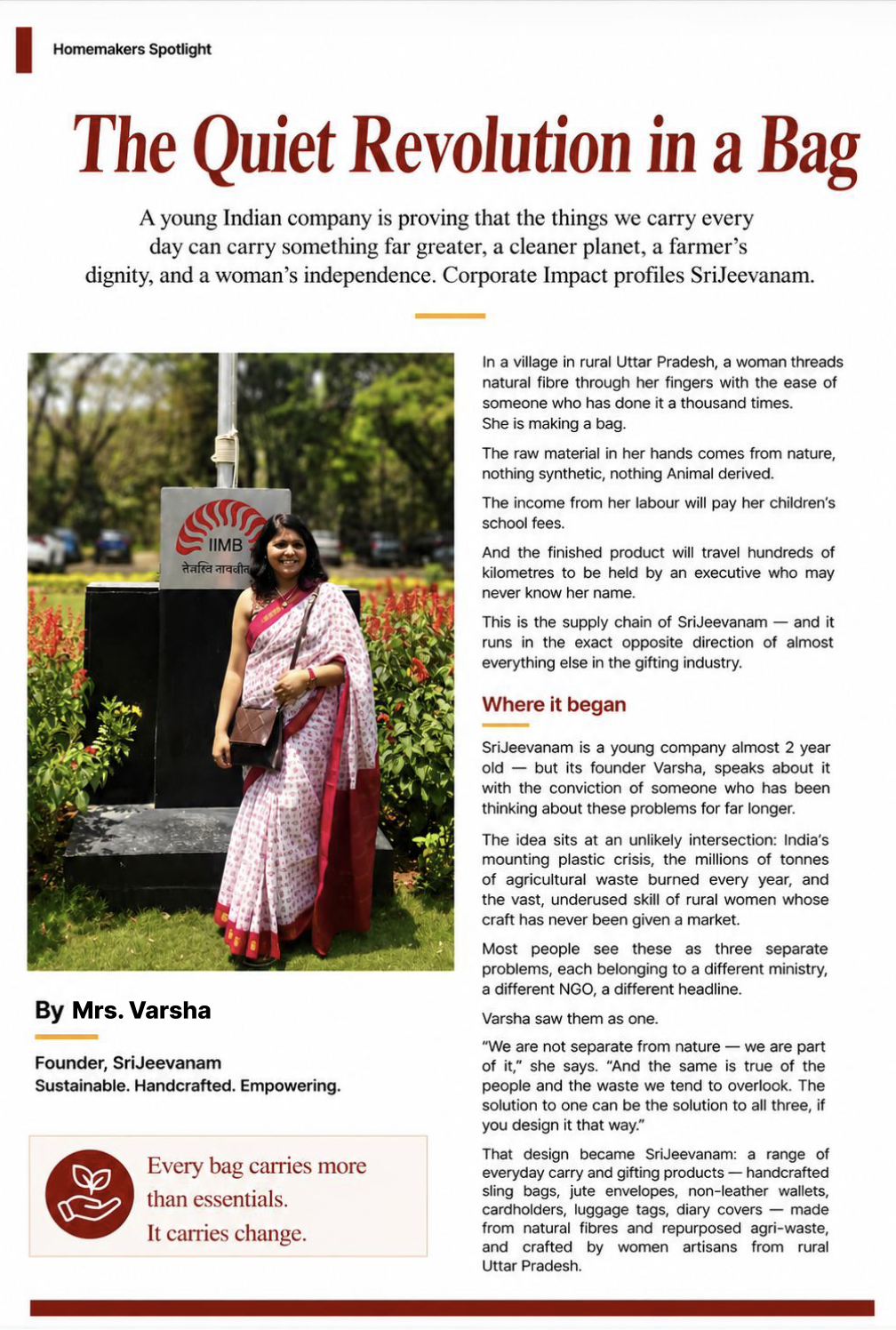
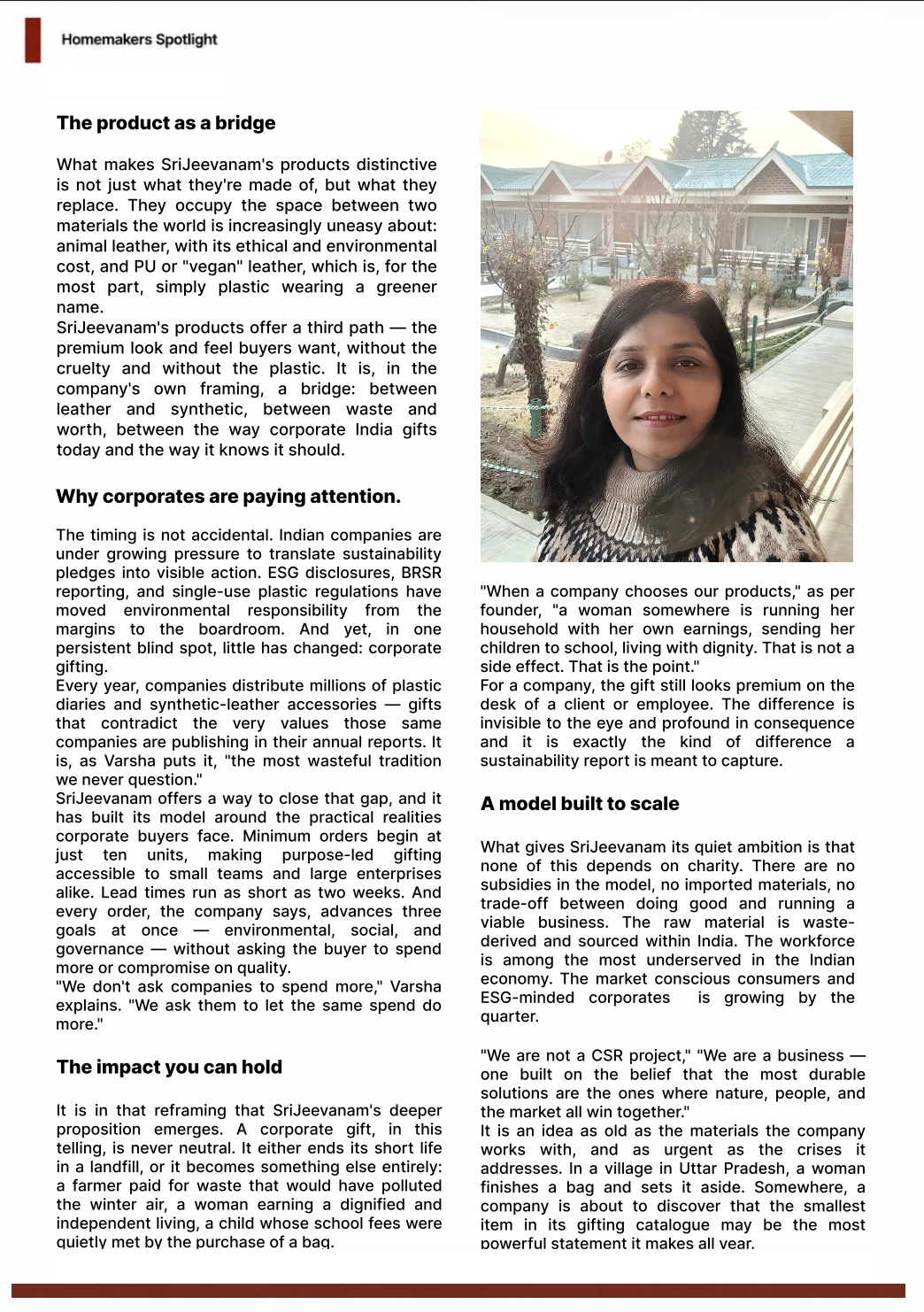
SriJeevanam is a young company almost 2 year old — but its founder Varsha, speaks about it with the conviction of someone who has been thinking about these problems for far longer.
The idea sits at an unlikely intersection: India's mounting plastic crisis, the millions of tonnes of agricultural waste burned every year, and the vast, underused skill of rural women whose craft has never been given a market. Most people see these as three separate problems, each belonging to a different ministry, a different NGO, a different headline.
Varsha saw them as one.
"We are not separate from nature — we are part of it," she says. "And the same is true of the people and the waste we tend to overlook. The solution to one can be the solution to all three, if you design it that way."
That design became SriJeevanam: a range of everyday carry and gifting products — handcrafted sling bags, jute envelopes, non-leather wallets, cardholders, luggage tags, diary covers — made from natural fibres and repurposed agri-waste, and crafted by women artisans from rural Uttar Pradesh.
The product as a bridge
What makes SriJeevanam's products distinctive is not just what they're made of, but what they replace. They occupy the space between two materials the world is increasingly uneasy about: animal leather, with its ethical and environmental cost, and PU or "vegan" leather, which is, for the most part, simply plastic wearing a greener name.
SriJeevanam's products offer a third path — the premium look and feel buyers want, without the cruelty and without the plastic. It is, in the company's own framing, a bridge: between leather and synthetic, between waste and worth, between the way corporate India gifts today and the way it knows it should.
Why corporates are paying attention.
The timing is not accidental. Indian companies are under growing pressure to translate sustainability pledges into visible action. ESG disclosures, BRSR reporting, and single-use plastic regulations have moved environmental responsibility from the margins to the boardroom. And yet, in one persistent blind spot, little has changed: corporate gifting.
Every year, companies distribute millions of plastic diaries and synthetic-leather accessories — gifts that contradict the very values those same companies are publishing in their annual reports. It is, as Varsha puts it, "the most wasteful tradition we never question."
SriJeevanam offers a way to close that gap, and it has built its model around the practical realities corporate buyers face. Minimum orders begin at just ten units, making purpose-led gifting accessible to small teams and large enterprises alike. Lead times run as short as two weeks. And every order, the company says, advances three goals at once — environmental, social, and governance — without asking the buyer to spend more or compromise on quality.
"We don't ask companies to spend more," Varsha explains. "We ask them to let the same spend do more."
The impact you can hold
It is in that reframing that SriJeevanam's deeper proposition emerges. A corporate gift, in this telling, is never neutral. It either ends its short life in a landfill, or it becomes something else entirely: a farmer paid for waste that would have polluted the winter air, a woman earning a dignified and independent living, a child whose school fees were quietly met by the purchase of a bag.
"When a company chooses our products," as per founder, "a woman somewhere is running her household with her own earnings, sending her children to school, living with dignity. That is not a side effect. That is the point."
For a company, the gift still looks premium on the desk of a client or employee. The difference is invisible to the eye and profound in consequence and it is exactly the kind of difference a sustainability report is meant to capture.
A model built to scale
What gives SriJeevanam its quiet ambition is that none of this depends on charity. There are no subsidies in the model, no imported materials, no trade-off between doing good and running a viable business. The raw material is waste-derived and sourced within India. The workforce is among the most underserved in the Indian economy. The market conscious consumers and ESG-minded corporates is growing by the quarter.
"We are not a CSR project," "We are a business — one built on the belief that the most durable solutions are the ones where nature, people, and the market all win together."
It is an idea as old as the materials the company works with, and as urgent as the crises it addresses. In a village in Uttar Pradesh, a woman finishes a bag and sets it aside. Somewhere, a company is about to discover that the smallest item in its gifting catalogue may be the most powerful statement it makes all year.