







































Freedom cannot become a shield against accountability. Constitutional rights are intended to protect dignity not to legitimise emotional exploitation or abandonment.
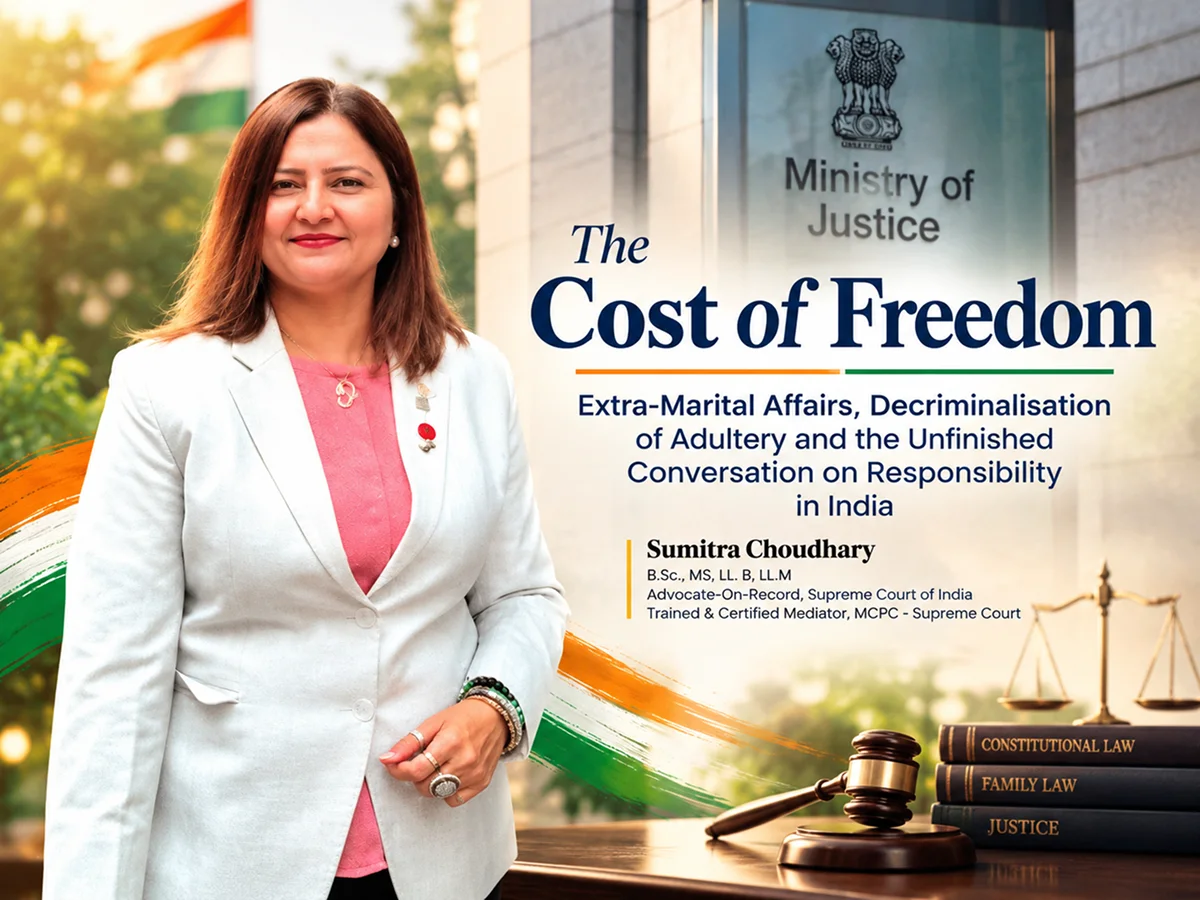
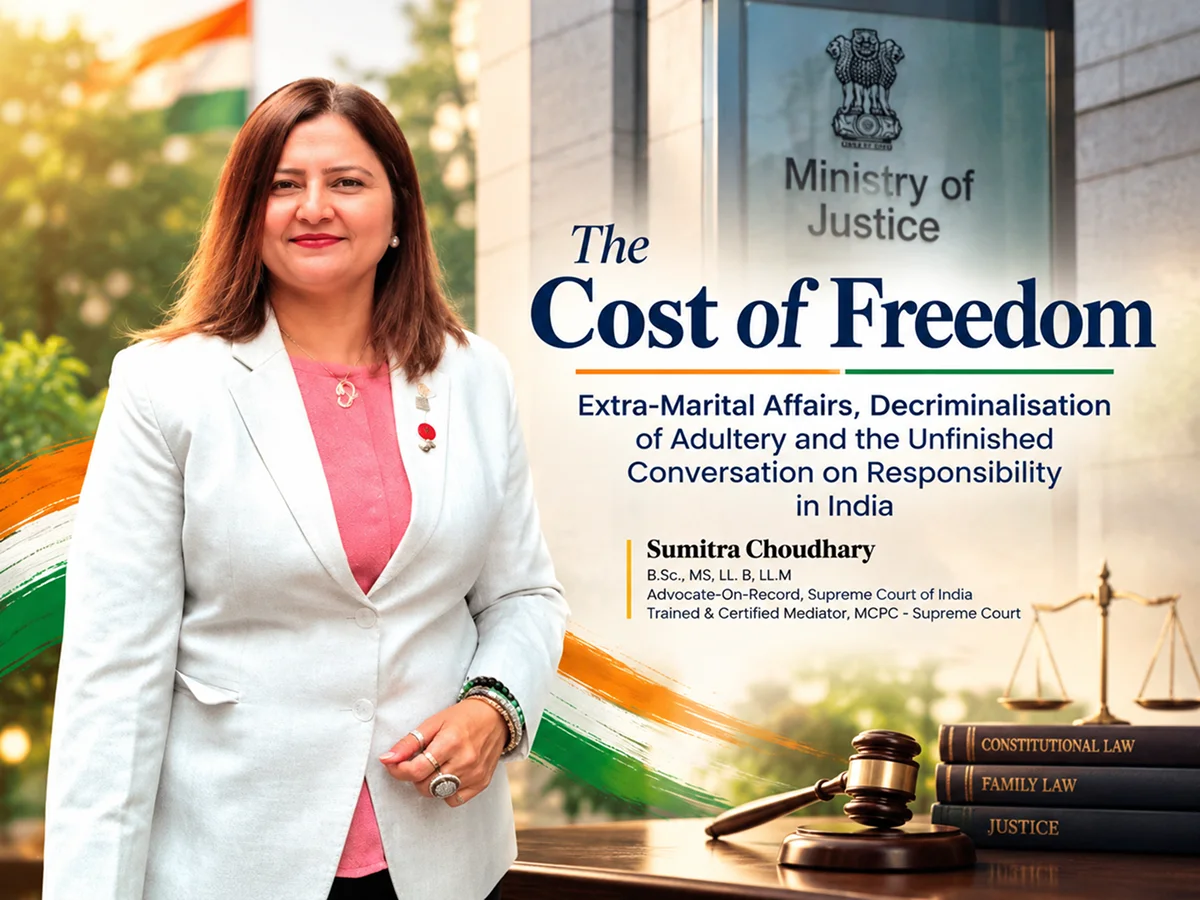
Sumitra Choudhary
B.Sc., MS, LL. B, LL.M
Advocate-On-Record, Supreme Court of India
Trained & Certified Mediator, MCPC - Supreme Court
In 2018, the Supreme Court of India delivered one of the most celebrated constitutional judgments in recent history. In Joseph Shine v. Union of India, it struck down Section 497 of the Indian Penal Code holding that adultery could no longer be treated as a criminal offence. The judgment was hailed as a victory for constitutional morality, individual autonomy, gender equality and personal liberty.
From a constitutional perspective the judgment corrected a deeply patriarchal law. Section 497 treated a wife as the property of her husband. The Law criminalised only the man who had sexual relations with a married woman without her husband’s consent while granting immunity to the woman herself. The provision neither recognised women as equal citizens nor punished a married man who had an affair with an unmarried woman. It deserved to go.
However, six years later now another conversation has emerged and this one deserves equal attention.
The question is no longer whether adultery should be a crime? The real question is whether society has mistakenly interpreted the judgment as the legal approval of irresponsible relationships?
There is an increasing perception that the decriminalisation of adultery has been misunderstood as the legalisation of infidelity, abandonment and emotional exploitation. While the Supreme Court removed the criminal sanction it never intended to remove the moral, civil or familial consequences arising from betrayal & breach of matrimonial trust.
The distinction has unfortunately been lost!
PAST: Marriage Was a Social Institution Not Merely a Private Choice
For Centuries, Indian society has regarded marriage as far more than a contractual arrangement between two people. It considered marriage as a sacred union often described as a bond transcending even seven lifetimes creating enduring obligations not only between husband and wife but also between two families and eventually towards their children. Marriage was understood to be the foundation of social stability, mutual responsibility and collective welfare.
While constitutional values have evolved to recognise personal liberty and individual dignity the underlying expectation of responsibility within marriage has remained central to the institution. The sanctity of marriage was never based solely on legal enforceability but upon mutual trust, fidelity and commitment.
PRESENT: Freedom Without Accountability?
The difficulty today lies not in the judgment itself but in how parts of society have understood it. Many people now casually say, “Adultery is legal” but technically “Adultery is not a criminal offence”. It is still a “Matrimonial Wrong”, a ground for divorce & a Civil wrong. The Court never declared adultery to be socially desirable nor did it declare marriage meaningless. The judgment merely recognised that the criminal law was not the appropriate instrument to regulate private consensual relationships between adults. Unfortunately, the popular narrative has blurred this distinction.
Rise of Casual Commitments, Promise to Marry and Convenient Consent !
Modern constitutional law recognises Personal autonomy. However, autonomy cannot become irresponsibility. Marriage creates legitimate expectations. Relationships create emotional dependence. Promises create trust and trust inevitably creates obligations. A truly progressive legal system must therefore ensure that individual freedom coexists with responsibility towards spouses, partners and children.
Another disturbing trend is the “Promise to Marry” being increasingly debated in courts. The trend that some men induce women into intimate relationships by promising marriage and later withdraw from those promises. In some cases, the relationship also results in pregnancy leaving the woman to bear the emotional, social and financial consequences alone. Some men frame every intimate relationship as a matter of absolute personal freedom while overlooking the responsibilities that arise when trust, dependence, pregnancy or family commitments become part of that relationship. Consent cannot become a convenient shield to escape accountability where trust has been deliberately cultivated and subsequently betrayed. The issue is therefore not consent alone but honesty, intention and accountability.
What about the children born out of such relationships?
Perhaps the most neglected aspect of this debate is the welfare of children born from unstable or abandoned relationships. A child does not choose the circumstances of birth yet the child bears the consequences throughout life. The emotional scars of parental betrayal, broken marriages, emotional abandonment, deprival of love and sense of security are the social cost of fractured relationships borne by children.
Parenthood cannot be reduced to financial maintenance alone. A father’s responsibility does not end because the relationship ended nor should the lifelong burden of raising a child fall exclusively upon the mother because one parent chose to walk away. Financial support though essential can never replace emotional presence, guidance, affection and shared parental responsibility. Legal rights alone cannot replace the emotional presence of responsible parenting. Children deserve more than legal rights, they deserve responsible parents !!
FUTURE: Building Responsibility in relationships
The future lies in strengthening a culture of responsibility. Society must recognise that legal liberty is not synonymous with ethical licence. A relationship between consenting adults remains a matter of personal choice but choices that affect spouses, partners or children can carry significant civil, familial and moral consequences.
Freedom cannot become a shield against accountability. Constitutional rights are intended to protect dignity not to legitimise emotional exploitation or abandonment.
The conversation today should therefore not be whether adultery ought to be criminal once again? The conversation should be whether our legal system and our social attitudes adequately recognise that freedom in intimate relationships carries responsibilities not only to partners but also to families and especially to children.
A mature constitutional democracy can protect both individual autonomy and the social importance of commitment. The challenge is not choosing one over the other but to ensure that liberty is exercised with responsibility and that the pursuit of personal freedom does not come at the cost of trust, family and the well-being of future generations.
_page-0001_result.webp)
_page-0002_result.webp)