




















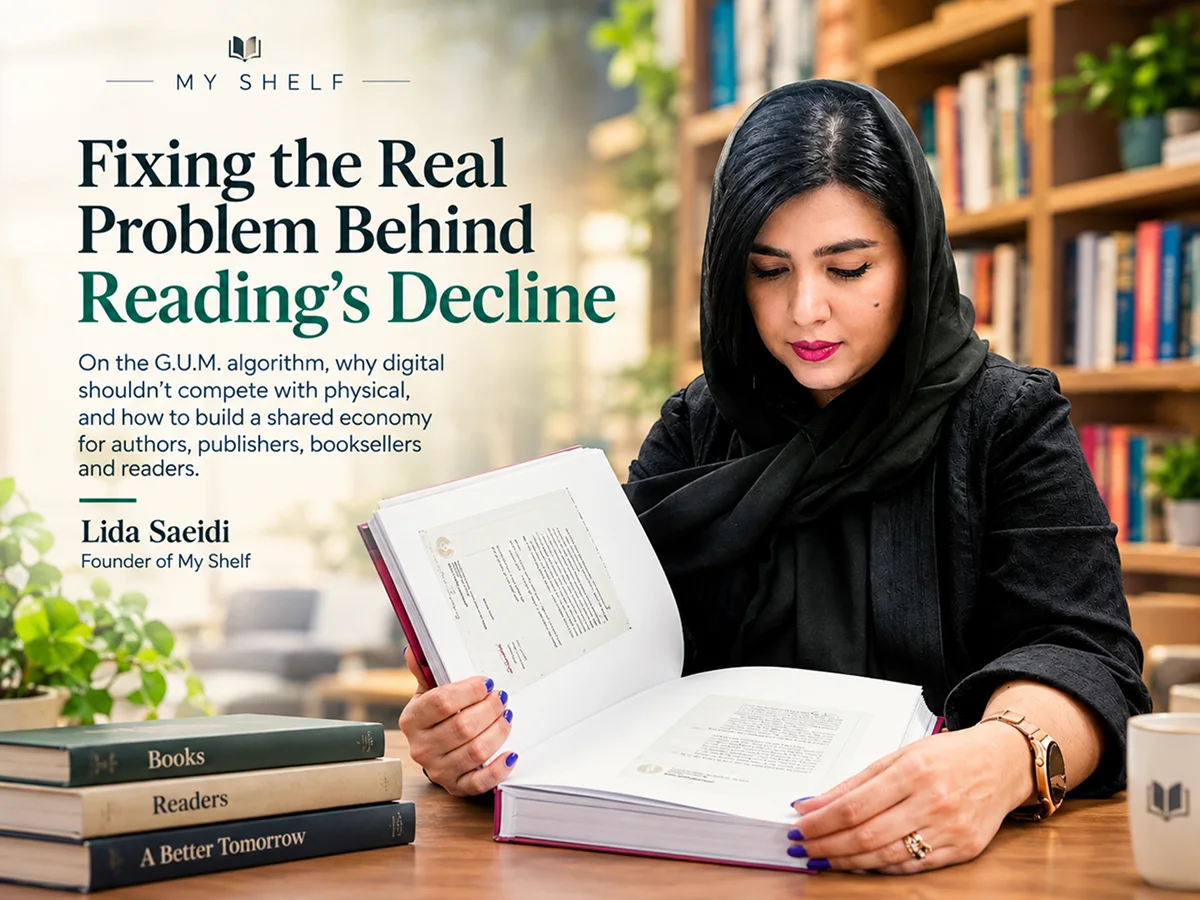











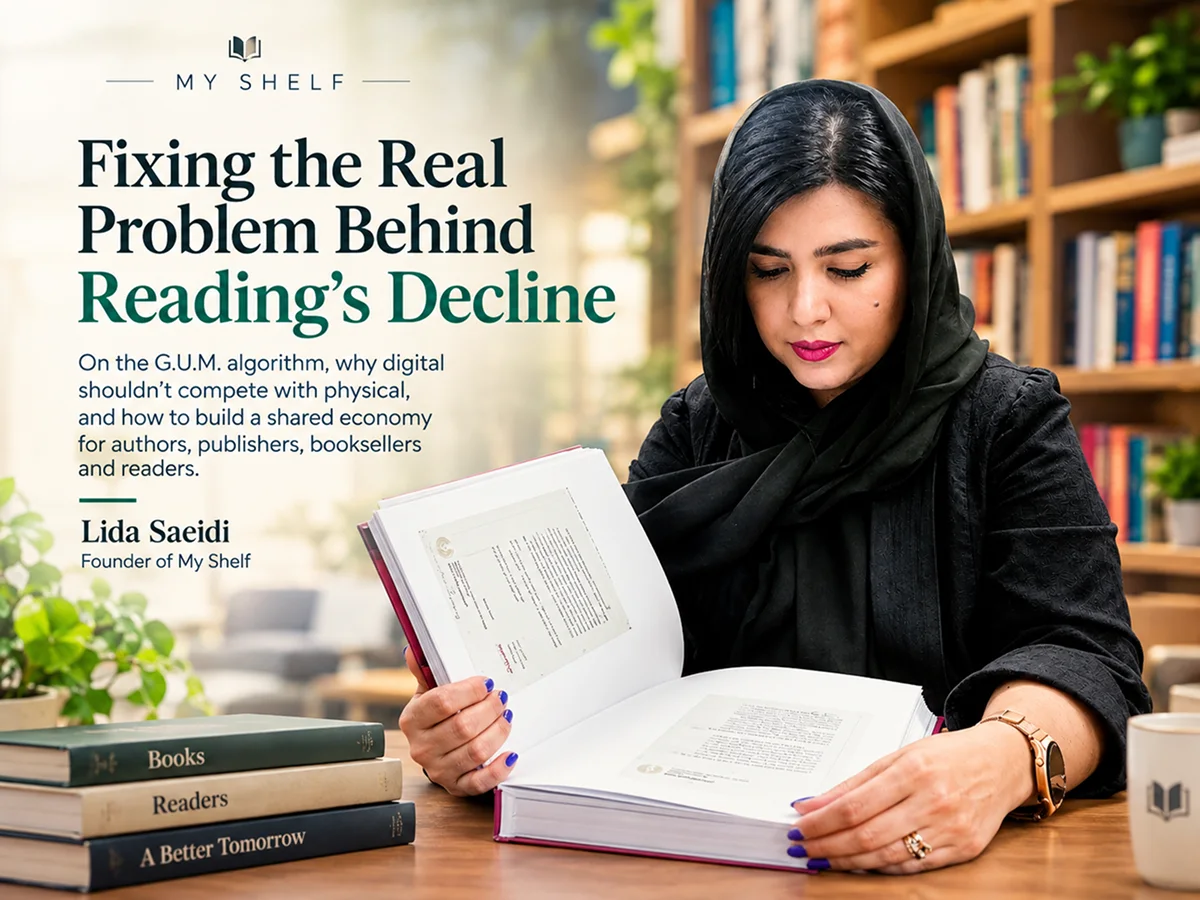
On the G.U.M. algorithm, why digital shouldn’t compete with physical, and how to build a shared economy for authors, publishers, booksellers and readers.
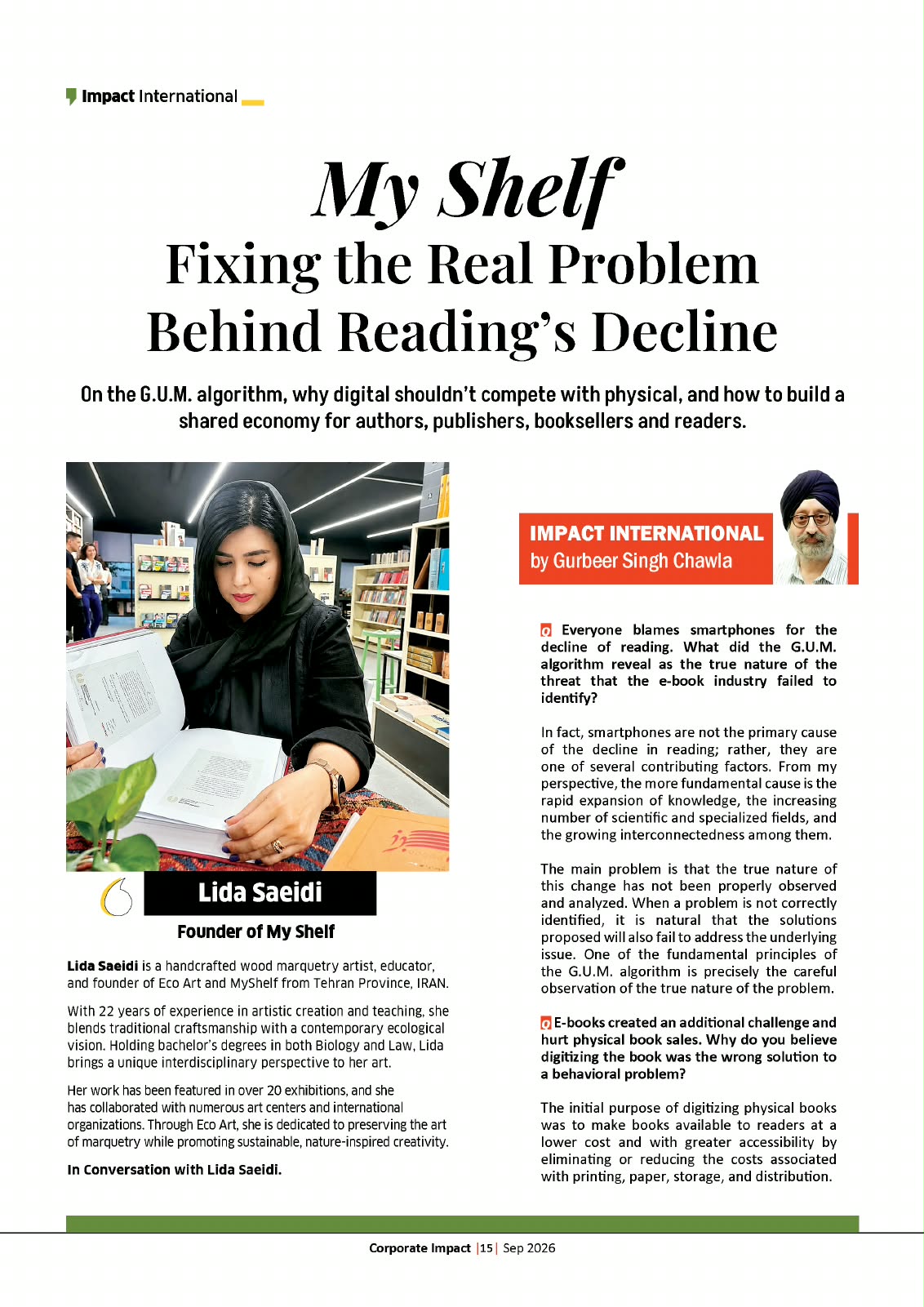
Lida Saeidi
Founder of My Shelf
Lida Saeidi is a handcrafted wood marquetry artist, educator, and founder of Eco Art and MyShelf from Tehran Province, IRAN.
With 22 years of experience in artistic creation and teaching, she blends traditional craftsmanship with a contemporary ecological vision. Holding bachelor’s degrees in both Biology and Law, Lida brings a unique interdisciplinary perspective to her art.
Her work has been featured in over 20 exhibitions, and she has collaborated with numerous art centers and international organizations. Through Eco Art, she is dedicated to preserving the art of marquetry while promoting sustainable, nature-inspired creativity.
In Conversation with Lida Saeidi.

Everyone blames smartphones for the decline of reading. What did the G.U.M. algorithm reveal as the true nature of the threat that the e-book industry failed to identify?
In fact, smartphones are not the primary cause of the decline in reading; rather, they are one of several contributing factors. From my perspective, the more fundamental cause is the rapid expansion of knowledge, the increasing number of scientific and specialized fields, and the growing interconnectedness among them.
The main problem is that the true nature of this change has not been properly observed and analyzed. When a problem is not correctly identified, it is natural that the solutions proposed will also fail to address the underlying issue. One of the fundamental principles of the G.U.M. algorithm is precisely the careful observation of the true nature of the problem.
E-books created an additional challenge and hurt physical book sales. Why do you believe digitizing the book was the wrong solution to a behavioral problem?
The initial purpose of digitizing physical books was to make books available to readers at a lower cost and with greater accessibility by eliminating or reducing the costs associated with printing, paper, storage, and distribution.
However, in practice, the way book digitization was developed and implemented created other consequences as well. Instead of functioning solely as a complement to the physical book, the digital version often became a competitor to it and had a negative impact on physical book sales.
In my view, the problem is not digitization itself, but rather how the relationship between the physical and digital versions is designed. If this relationship is designed correctly, the two formats can strengthen one another rather than weaken each other.
You claim “the cost of purchasing the original physical book will be returned to the buyer.” Can you walk us through exactly how My Shelf makes this possible? What is the business loop?
This is one of the most important and fundamental components of My Shelf, and at this stage I cannot publicly disclose the details of how the mechanism works.
The reason is the innovative nature of the model and the need to protect the core idea and mechanism until the appropriate time. However, once the right conditions are established and disclosure of the details becomes possible, I will certainly explain the mechanism in full.
How does My Shelf ensure that if the buyer gets their money back, the author, translator, publisher, and bookstore still profit - and even profit more than before?
At first glance, this may seem impossible or even contradictory. However, one of the core features of My Shelf is precisely its design to distribute economic benefits among all participants in the book value chain.
The author, translator, publisher, bookseller, and buyer can all benefit from this model. This is not achieved by reducing the share of one party in favor of another, but through the way the system is designed based on the G.U.M. algorithm.
In other words, My Shelf is designed so that the interests of different participants in the book ecosystem do not compete against one another, but instead become part of a shared economic cycle.
You expect Gen Z to be the most enthusiastic. Why would a generation that lives on smartphones want to buy more physical books through My Shelf?
Yes. One of the particularly interesting findings observed during the initial research was the more positive response from Gen Z.
This result was based on the questions and feedback received from the sample population that was studied. The design of My Shelf, based on G.U.M., does not place digital technology in opposition to the physical book. Instead, it uses digital capabilities to strengthen the reader’s connection with the physical book.
Therefore, the widespread use of digital technology by Gen Z does not necessarily mean that they are moving away from physical books. The key issue is how this relationship is designed.

How will My Shelf revitalize public libraries? What is their new role in your model?
The original idea behind My Shelf was, in fact, developed with the aim of creating a form of centralized digital library.
However, one of the characteristics of the G.U.M. algorithm is that the results obtained through the observation and analysis of one problem can also be generalized to related fields. For this reason, the scope of the idea is not limited to books. In later stages, it can also encompass magazines, newspapers, articles, and other forms of written content.
As a result, libraries can also take on a new and broader role within this ecosystem—a role that is not limited merely to storing and lending books.
Are you building a retail company, a cultural movement, or a tech platform? How do you define My Shelf?
Initially, the primary objective of My Shelf was to create a centralized digital library.
However, throughout the development of the idea, and based on the potential that the G.U.M. algorithm has revealed, My Shelf can go beyond being a retail company or a technology platform. If implemented correctly, it could evolve into a cultural movement in the field of books and reading.
What stops a large player like Amazon or a major publisher from copying this model once you prove it works? What is your moat?
In the world of technology, registering an idea or invention alone cannot always provide complete protection against imitation or copying.
My primary concern is not simply protecting ownership of the idea, but ensuring that it is implemented correctly. If this model were copied or implemented without a precise understanding of the principles and logic behind it, instead of creating a healthy cycle, it could concentrate very significant economic benefits in the hands of a limited number of powerful players. Ultimately, this could harm the rights and interests of authors, publishers, booksellers, and even book buyers. For this reason, I do not consider the main competitive advantage of My Shelf to be merely a technical feature or a legal registration. Rather, I see its core advantage in the logic behind the system’s design, the G.U.M. algorithm, and the way its different components are interconnected.
Your solution is based on “accurate and real data.” What data did you test My Shelf on, and what were the initial results or pilot feedback?
One of the fundamental inputs of the G.U.M. algorithm is the careful observation and examination of information.
For this reason, the information and data used in designing and analyzing this model have been selected and examined with great care and attention. The objective has been to study the issue of books and reading not from a superficial perspective, but through careful observation of the factors influencing reader behavior and the structure of the publishing industry.
In my view, one of the reasons for the negative consequences associated with the current e-book model is precisely that the underlying problem was not observed and defined accurately enough.
If My Shelf is implemented successfully at scale for 5 years, what will the book industry look like? What does success look like for a reader india or a publisher in Tehran?
Based on the design of My Shelf, which is one of the products of the G.U.M. algorithm, the physical book and its electronic version are not designed to compete with each other. Instead, they are designed in a way that allows them to reinforce and strengthen one another.
In such a model, success would not be measured simply by the number of books sold or the revenue generated by a company. Success would mean that readers receive greater value, authors and translators receive a fairer share, publishers and booksellers benefit from a sustainable economic cycle, and, ultimately, the culture of reading is strengthened.
Over a five-year horizon, the goal of My Shelf could be to establish such an ecosystem within the book industry and then expand it to magazines, newspapers, articles, and other forms of written content.