








































Ebola Crisis Spirals in DRC — The 17th Outbreak, and Still No Cure
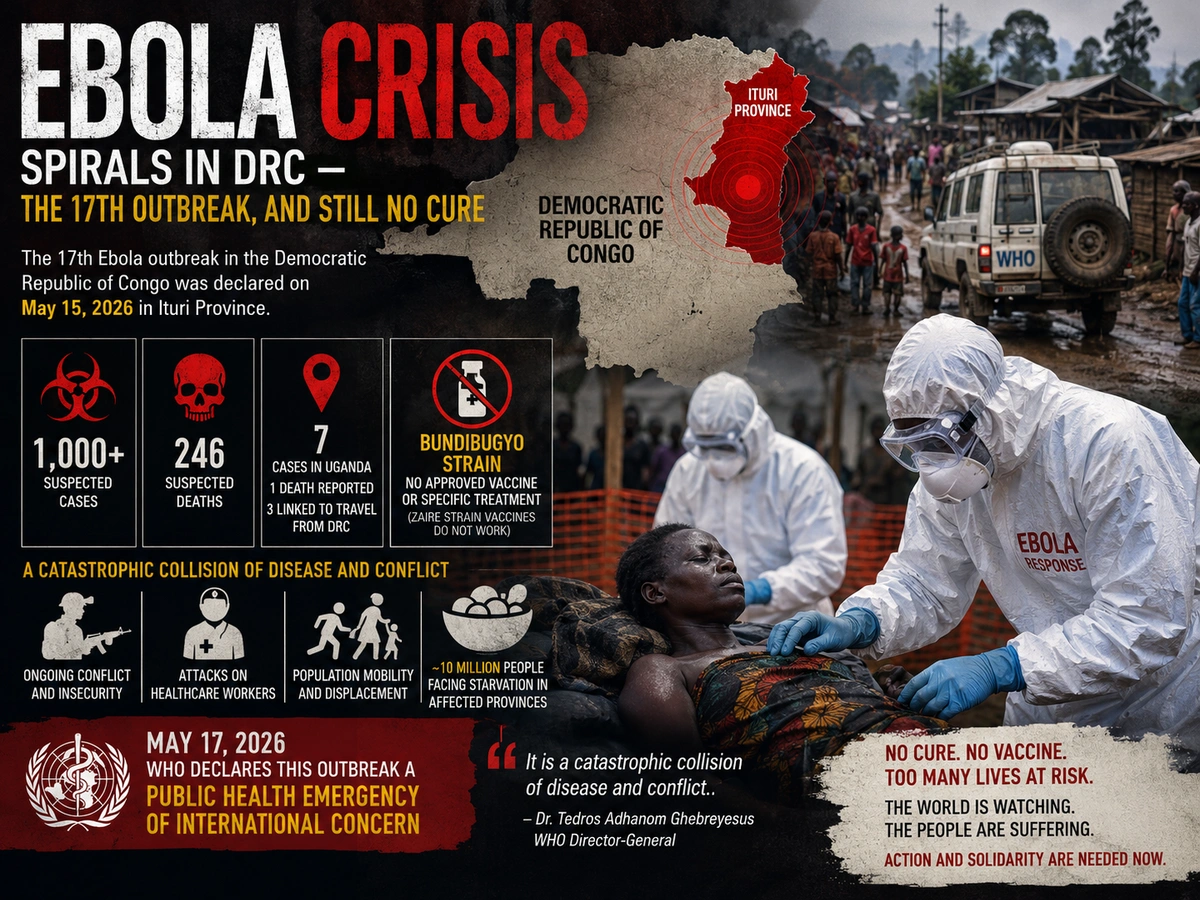
The Democratic Republic of Congo (DRC) is once again confronting one of the world’s deadliest infectious diseases. On May 15, 2026, the country’s Ministry of Health announced a new Ebola outbreak in Ituri Province, located in northeastern DRC. This marks the 17th recorded Ebola outbreak in the country since the virus was first identified near the Ebola River in 1976.
What began as a localized health concern has rapidly evolved into a major humanitarian and public health crisis, raising alarm among international health organizations and neighboring countries.
Cases Continue to Rise
Health officials have reported more than 1,000 suspected Ebola cases, alongside approximately 246 suspected deaths. The outbreak is spreading across a region already burdened by armed conflict, weak healthcare infrastructure, and large-scale population displacement.
Neighboring Uganda has also reported confirmed Ebola infections linked to travel from the Democratic Republic of Congo. Authorities confirmed that seven individuals tested positive for the virus, with one fatality recorded, underscoring concerns about cross-border transmission.
As the virus spreads, healthcare teams are struggling to contain infections in remote and insecure communities where access remains limited.
The Challenge of the Bundibugyo Strain
One of the most concerning aspects of the current outbreak is the specific strain involved. The outbreak is being driven by the Bundibugyo strain of Ebola virus, a less common variant for which no approved vaccine or targeted treatment currently exists.
While medical advances in recent years have produced effective vaccines against the Zaire strain of Ebola, those protections do not extend to Bundibugyo. Researchers and pharmaceutical developers are actively working to develop preventive and therapeutic solutions, but none have yet received regulatory approval.
This lack of available medical tools significantly complicates response efforts and increases the urgency of containing transmission.
A Humanitarian Emergency Beyond Disease
The Ebola outbreak is unfolding amid an already dire humanitarian situation. Years of conflict, armed violence, and displacement have weakened public health systems and disrupted essential services across eastern DRC.
According to World Health Organization Director-General Dr. Tedros Adhanom Ghebreyesus, the region faces a “catastrophic collision of disease and conflict.” Healthcare workers encounter enormous challenges in tracing contacts, monitoring infections, and isolating suspected patients due to insecurity and constant population movement.
Attacks against healthcare facilities and aid workers have further hampered emergency response efforts, making it increasingly difficult to establish effective disease surveillance systems.
At the same time, nearly 10 million people across affected provinces are facing severe food insecurity and hunger, creating additional vulnerabilities among already struggling communities.
WHO Declares Global Health Emergency
Recognizing the escalating threat, the World Health Organization formally declared the outbreak a Public Health Emergency of International Concern on May 17, 2026.
The declaration is intended to mobilize international resources, strengthen surveillance, improve coordination between countries, and accelerate research into vaccines and treatments for the Bundibugyo strain.
Global health experts warn that rapid intervention will be essential to prevent wider regional spread and reduce loss of life.
A Crisis That Keeps Returning
For many people living in eastern Democratic Republic of Congo, Ebola is not a new threat. Communities have repeatedly faced outbreaks over the past five decades, often while enduring conflict, poverty, and displacement.
As the world watches developments unfold, residents of the affected regions continue to confront the devastating realities of disease outbreaks that return time and again. The current crisis serves as a reminder that global health security depends not only on medical innovation but also on addressing the underlying humanitarian and security challenges that allow epidemics to flourish.
The battle against Ebola continues, and for thousands of families across eastern DRC, the outcome remains uncertain.