








































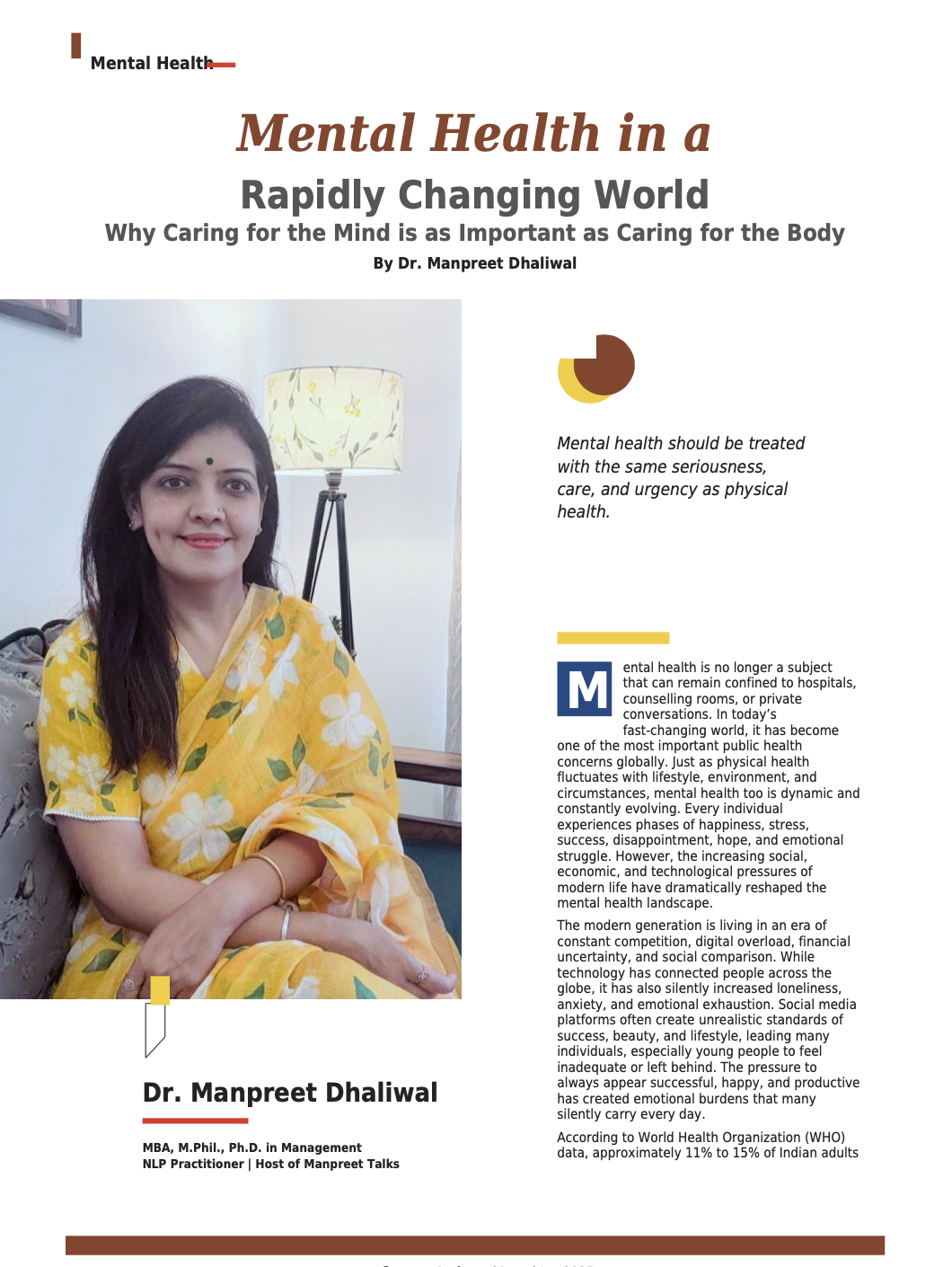
Mental Health in a Rapidly Changing World
Mental health is no longer a subject confined to hospitals or counselling rooms. In today’s fast-paced world, emotional well-being has become one of the most important public health concerns globally.
Modern lifestyles filled with digital overload, social comparison, financial uncertainty, and constant pressure to succeed are silently affecting millions of people emotionally. While technology has connected the world, it has also increased loneliness, stress, anxiety, and emotional fatigue.
Dr. Manpreet Dhaliwal explains how dopamine, the brain’s “feel-good chemical,” plays a major role in emotional balance, motivation, and positivity. However, unhealthy lifestyles, excessive screen time, poor sleep cycles, and constant digital stimulation are negatively affecting emotional health and increasing mental disorders like depression and anxiety.
Depression is not temporary sadness but a serious medical condition that affects thoughts, emotions, concentration, energy levels, and daily life. Across age groups, people silently struggle with emotional stress due to academic pressure, workplace stress, financial instability, and social isolation.
The article emphasizes that mental health is a collective social responsibility. Families, schools, workplaces, and governments must work together to create emotionally supportive environments. Seeking counselling or therapy should be normalized and treated with the same seriousness as physical healthcare.
Lifestyle improvements such as exercise, mindfulness, meditation, gratitude, social connection, and healthy sleep can significantly improve emotional resilience and mental stability.
In the end, emotional well-being is not a luxury but a necessity for a balanced and meaningful life. Every mind matters, every emotion matters, and every life matters.